This branch of the Austrian Hesch family is descended from Johann Hesch and his wife Marya (Schlinz) Hesch, who came to America from Oberschlagles, Bohemia with three sons: Paul, Mathias, and Anton. +++Johann & Marya settled in Buffalo County, Wisconsin but moved to Pierz, Mn in about 1885. .+++Mathias settled in Waumandee, Wisconsin and moved to Pierz in 1911. +++Anton never married but farmed with his dad in Agram Township, where he died in 1911.+++And Paul, my great grandfather, settled five miles away, in Buckman, Minnesota. He died there in 1900.

: : : : : : : : : : : :
Showing posts with label Bohemia. Show all posts

Monday, September 4, 2017

Planting and harvesting

On the way home from the cities one day last summer, Mog and I noticed something interesting about a corn field.  The first few rows of corn were harvested all the way around, as far as we could tell.  We speculated, as you do, about why.  Maybe to allow more air circulation to help dry the crop...or maybe the farmer was getting low on feed for the cows, that could be it.  Hmm, maybe the outside was the least productive or something...none of it seemed right, because we saw another field like that, and two more.  With a mighty shoulder shrug, we figured we'd find out the real reason eventually.

So hooray! Mog called this morning and had the answer.  She's been at her sisters house, and happened to talk with a farmer friend.  He said no, none of the above ☺.  He said you plant the straight rows and turn around at the end of the field, within the field.  Then the last pass is around the outside of the whole field.  
In the fall, you harvest that outside ring first, so again, you can turn around within the field.  Isn't that cool?

A bit later, Larry and I were talking on IM, surprise! ☺.  I told him the crop saga, and he was suitably impressed.  It reminded him of the biblical admonition to save the corners for the poor.  Wha...?  I must have missed that chapter:
“And when you reap the harvest of your land, you shall not reap your field right up to its edge, nor shall you gather the gleanings after your harvest. You shall leave them for the poor and for the sojourner"  Leviticus 23:22
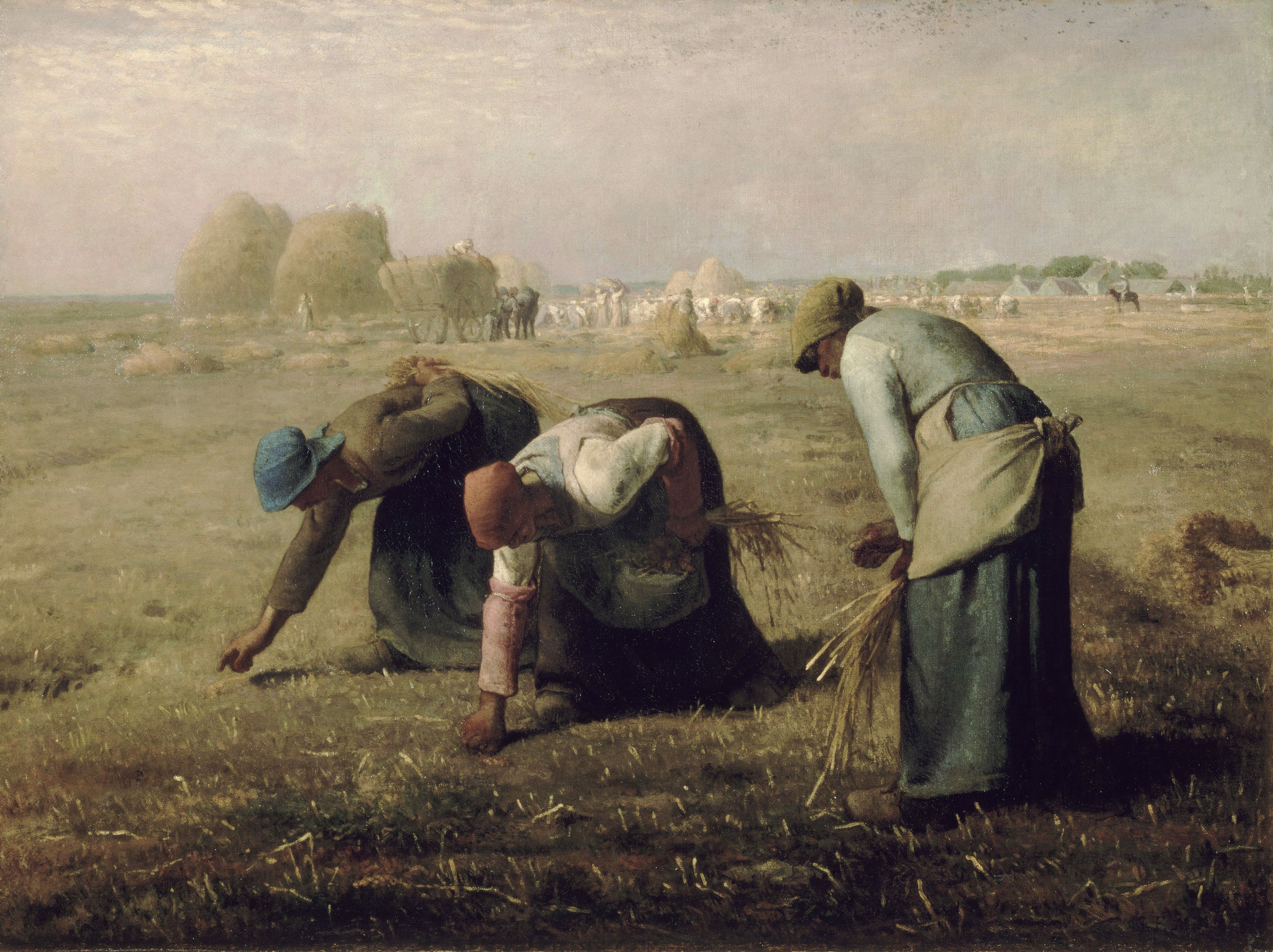
I said "Huh?" and Larry mentioned the painting by Jean-Francois Millet called The Gleaners (here's the zoomable version--I highly recommend it).    
The more we talked about the story in the painting, the more familiar it seemed.  There are upwards of 20 men in the background, harvesting shocks of grain--stacking them on the wagon to be piled on the--wow, there are 12 or so mountains of shocks.  There's an overseer on a horse, and farm buildings in the way-background.  Three women are picking up the leftovers in the foreground.

Which relative had this print on their wall? Look at the small, snug bundles behind the women, and the bend in their backs.  One online description of the painting said the women were well-dressed and healthy looking, as tho this was a lark for them, just something to pass the afternoon.  But no--zoom in--these women need every kernel.  I doubt they thought of the landowner as particularly generous....and then, you know, this scene happened all over Europe in those years, and definitely in Bohemia.  Wow, these really are the values we grew up with, if you ignore the dire poverty part:  "Work together"..."Get all you can"..."Don't whine"...."A little sweat never hurt anybody"...."work is noble"..."waste not, want not"

...it's your own fault if you go hungry because it's there to be gleaned...

Thursday, January 29, 2015

The Neuhaus "White Lady"

Ooooo--A ghost story! From an article in an Ohio newspaper in 1871.  Larry found it on the Library of Congress website (fifth column). No, it probably wasn't breaking news to anyone in Urbana, Ohio that March, but it would have been a good story, and if you were practicing your English, the connection with Europe would have been interesting.
More than likely, the original Pawel Hesch and his son Martin (and his son Johann) knew about the legend and probably believed there was a White Lady who roamed the castle.  Did they tell the story to our great grandfather Paul, and did he take it with him to America?  Was it maybe something he told his own kids  on the homestead west of Buckman?
I find it really odd that the author says it was the SAME White Lady haunting castles all over Europe.  Couldn't central casting find any other disgruntled dead women to haunt their own castles?
(BTW, Neuhaus was the German name for Jindrichuv Hradec, the larger town less than 5 miles from where our ancestors lived...)
THANKS, LARRY! ☺

Sunday, July 20, 2014

A Feuerspritze for Schamers

It's such a delight to have a kindred spirit in Su, our genealogical doppelganger across the Atlantic.  Our shared fascination with the details of living a couple hundred years ago in a tiny berg in Bohemia gives all three of us new insights that we might have missed out on otherwise.
  
We assume YOU share an interest cuz you're here ☺. 

Su is writing about Schamers, the nearby market town where our family traded. The info's not directly related to Heschs, but it gives us an idea of what daily life was like, and it gives Su a way to summarize and share her translations and research.  We all win.  However, she warned, this letter might require two cups of coffee AND a donut...

BTW, the "Heimatskunde" is a book written by Josef Binder, our private saint.   Herr Schemiceck's "Chronicle of Schamers" was the official account of day to day life in the village.  It's written, longhand, in old German.  Herman is Su's venerable 1942 German-English dictionary. 

Dear Marlys,
Sometimes, when tired of wrestling with Google translate, several other translation engines and dear Herman with his minute Fractur print, I idly leaf through Cousin Joe's Heimatskunde, grasping at words I can understand like a drowning man clutches at straws.
The modern edition of the Heimatskunde that I have is a scan (of slightly variable quality) of the original, which was printed in a variety of Fraktur. I have a lot of trouble distinguishing between the 'long' s and lower case 'f 'and it is very evident from the things google translate has been having hiccoughs over that the original type-setter occasionally got rather muddled as well! Despite the difficult grammar I do like German; it amuses me so much as some words are so similar to English but with a funny twist to them. There is literalism and
earnestness that can be both exasperating and endearing.


There are some words in the following passages that particularly amuse me but might be different in American English. In vernacular UK English the word for a man or woman employed to put out a fire is Fireman or (in these days of equality) Firefighter. The powerful vehicle that carries a crew of fire-fighters, a tank of water, a pump and a hose, has a bell/klaxon/siren to draw attention to itself and is usually painted bright red and silver is commonly known as a Fire Engine and the place it is stored in (be it very large or only as big as a domestic garage) is a Fire Station. The body that organizes the nation-wide coverage and to which all these things belong is the Fire Brigade or Fire Service. I have no doubt that in these days of political correctness and curiously evasive job titles all these items have different names within the service itself but if you called the emergency services and asked for a fire engine and firemen to come and help you the right sort of thing would (hopefully) arrive.


In the time of Josef Binder's Heimatskunde, firefighting was a different beast because all the power needed to work it was generated by men or possibly horses. So a modern fire-engine is ein Feuerwehrauto but the Heimatskunde uses the word Feuerspritze which google insists is a 'fire syringe'! I have a wonderful mental images here of the voluntary firemen bravely dragging forth a huge medical syringe and hypodermic needle then sending it careering through the streets of Schamers to surgically inject water into the flaming building followed by minor explosions, squawking chickens and burning wheels falling off in the best black and white silent movie style. Herman says a better translation would be a Fire Squirt but it is still very amusing and just changes the image to one of a gang of puffing men working the pump for all they are worth and half the water escaping through leaks and holes while a mere trickle comes out of the hose. Today a Fire Station is eine Feuerwehrstation but in the Heimatskunde it is, delightfully, the Spritzehaus and thus the Syringe House or the Squirt House. It really can't get much better.

Heinz told me that No. 40 Schamers (Granddad Ludwig's birthplace) had been

rebuilt after a fire in in 1843 but I did not realize that several other houses had been burned down at the same time. This explains why Nos 39- 43 (excluding No. 42 which of course was rebuilt again in 1894) all look so similar in size, shape, construction style and alignment. It is even more striking if you look at the aerial view you can see on Google. How terrifying it must have been: the lowing cattle, screaming horses, the panicked grabbing of things most dear when suddenly awoken from sleep. It was winter; did they have time to put on warm clothing over their night clothes, and what a grim time of year to lose everything - I wonder how they all managed. I know the winters can be bad in central Europe; was the stream at the bottom of their gardens frozen so they could not get enough water or was it just so quick that nothing could be done?

The Heimatskunde reports this very fire in Chapter 19, page 327:

Schamers ein Schaden[s]feuer aus, bei welchem die Privathäuser Nro. 39, 40, 41, 42, 43 und 45, dann das Rathaus Nro. 45 ein Raub der Flammen wurden. On the eighth February 1843 broke early between 4 and 5 o'clock clock in the markets town of Schamers damaging from fire, at which the private houses Nro. 39, 40, 41, 42, 43 and 45, then the Town Hall Nro. 45 [fell/became]a prey to the flames.

Von den niedergebrannten Häsern waren Nro, 41, 42 und 43 bei der Triester Azienda assecuratrice versichert. 
Of the burnt houses were Nos. 41, 42 and 43 insured with the Triester Azienda assecuratrice.
Aus der erhobenen Sachlage ging die Vermutung hervor, dass das Feuer durch das Abholen des Viehfutters aus der Scheuer am Tage des Brandes früh beim unverwahrten Lichte oder brennender Pfeife verursacht worden sei. 
From the collected facts, the presumption, it appeared that the fire was caused by the collection of animal feed from the barn on the day of the fire in the morning on unexpected/unguarded light or a burning pipe.

This was just the most recent of many fires recorded in the Heimatskunde and it must have been an ever present danger with hay, straw, flax, wood and similar materials stored in the barns next to the houses, the dwellings themselves made of flammable materials and the only sources of light and heat an open flame of some sort. Most of the roofs in that area are now made of clay tiles but it is possible that they were once made of wooden shingles, the most likely roofing in a well forested area. There may not have been open fires in the houses as the Austrian/German kachelofen or ceramic tiled closed stove has been around for a very long time as shown by the illustration from a medieval manuscript.

Note that the man has removed a boot and his hose (leg coverings) and is toasting his presumably frozen foot in the radiant heat while supping something comforting. A piece of bacon hangs temptingly from a rail over his head. I do not know if such stoves were restricted to the better off or were common to all regardless of income. They were safer because the fire was better controlled, very efficient in their use of fuel because the hot gasses were made to follow a very circuitous route to the chimney by a complicated system of internal baffles and the likelihood of sparks escaping up the chimney into the open was much reduced, and they remained warm for the whole 24 hours. I once came across a kachelofen in an Austrian Climbing Hut that had glazed flowerpots built into the domed top. This was a very old design intended to increase radiation by increasing the surface area They were a handy place to dry wet socks over night; one pot comfortably held one pair of thick woolen socks. Josef Binder, writing of No 42, the house in which he was born, rebuilt after the disastrous fire of 1843 reported that:

Dieses alte Bauernhaus enthielt eine große Bauernstube, wo noch eine Hängwleuchte war; neben dieser Bauernstube war das Stubengewölbe und
hernach der Backofen angebracht, worauf die Kinder zu schlafen pflegten. 

This old farmhouse contained a large parlor, where there was still a hanging lamp, beside the peasant's room the vault room, and afterwards, the oven was installed whereupon the children used to sleep.

Gegenüber vom eingange ins Wohnhaus, nämlich vom Hofraume aus, war ein Vorhaus und dann kam man in die schwarze Küche, wo auf offenem Herde zur warmen Jahreszeit die Speisen gekocht wurden.
Across from the entrance into the house, namely the court-yard was from a
vestibule and then you came into the scullery where were on open stoves for the warm season, the food cooked. 

Im winter geschah das Kochen der Speisen in großen Kachelofen bei einer Heizung von der Küche aus. 
In winter the cooking of the food took place on large tiled stove that heated the kitchen. (Chap. 20 page 350).

The newly (2013) renovated No 40 Schamers (also rebuilt after the fire of 1843) has something similar  (left) although how close that is to the original in the house I have no idea.
The one at No 42 may have been more like this (see below right) from The Folk Architecture Museum at Kouřim, Cz.  The blue stove and its surround provides something like the sleeping area for children and has the ubiquitous drying rail above it. The important thing

was that the basic construction should be massive; either of brick or stone or soil but the outer finish was probably a matter of taste or economics. Plaster would do, but ceramic tiles, so easily wiped clean, would have been a boon to the busy housewife and no double a source of some considerable domestic pride.

Whatever the cause, in an outbreak of fire the people had to help themselves so
Im Jahre 1876 wurde eine Feuerspritze um 600 Fl. angekauft; dieselbe ist von Ferd.  Hilgartner verfertigt worden. (Chap.19; page 340.) 

In 1876, a fire engine to 600 Fl. purchased; the same is by Ferd. Hilgartner been manufactured.
Eventually, a formal volunteer Fire brigade was organised and cousin Joe tells us about that too:
Der freiwillige Feuerwehr-Verein in Schamers
Der freiwillige Feuerwehr-Verein wurde im Jahre 1889 gegründet.
The Volunteer Fire Club in Schamers  

The Volunteer Fire Department Association was founded in 1889.
Obmann war Jakob Longin, Oberfehrer, Stellvertreter Ferdinand Binder, Kassier
Fucker Ludwig und Schrift-führer Johann Schimeczek.
 

Chairman was Jacob Longin, chief officer, deputy Ferdinand Binder, Treasurer Ludwig Fucker and font-leader (chief or maybe Fire Fighter] Johann Schimeczek.

Im Frühjahre 1890 bekam der Verein die erste neue Saugspritze, welche die Firma "Smekal" aus Prag um den Betrag von 900 fl. lieferte. 
In early 1890, the club got the first new suction pump, supplied by the company of "Smekal" from Prague [see below*] by the amount of 900 florins.

Im Jahre 1895 erhielt der Verein die zweite Saugspritze, welche
von der Firma Ischermak in Teplitz um der Betrag von nahe 900 fl. gekauft
wurde. 

In 1895 the club received the second suction pump, which was bought by/from the company Ischermak in Teplitz for the amount of near 900 fl.
Bürgermeister Ludwig Fucker. Der Verein zählte im Anfange 64 wirkende
Mitgleider.
 

The firehouse was built in 1891 under the Mayor Ludwig Fucker. The
association had 64 acting members in the beginning. (Chap. 22 page 367)

Note that Ferdinand BINDER was the deputy chairman of the voluntary fire
brigade. This is the Ferdinand BINDER (Granddad Ludwig's godfather and his mother Antonia's cousin) who appears as an old man with two of his brothers in front of No. 42 in the photo you posted on March 4 2014. He had good reason to support a fire service because his parents Anton and Josefa BINDER (also the parents of our St Joe) had been made homeless in the fire on 8th February 1843 when Josefa was 5 months pregnant with their first child.  Anton's younger brother Josef, (Rob's great, great Grandfather) as yet unmarried, was also made homeless because he was living at No. 40 with his parents.


No doubt Ferdinand and all his siblings and cousins grew up on the stories of the day the house burnt down and were probably taught to be very careful with fire. Note that the building on the right behind the 'fire squirt' appears to be roofed with shingles -the 'tiles' seem to have worn, ragged, lower edges, characteristic of old shingles, in a way that clay tiles do not.

The Volunteer fire Brigade in Schamers formed in 1889

*My first translation of this sentence wasn't very accurate and I was curious as
to whether the new fire engine was called 'Smekal' because that was its brand name or whether it was just an affectionate nickname, but on googling it I found a wealth of information. There was a Czech firm called Smekal who manufactured fire engines and were active from 1820 to 1940 and a book was written about it by Josef Jendrisak. They made both man and horse-drawn machines, and by 1891 were incorporating steam-powered pumps. Goodness me, you thought we were obsessed but there's a world-wide register of old fire engines still in existence and an entry about the company there. It's hard to tell from the photograph what type of engine the Schamers brigade had but it was quite a wealthy community and I think I can see the top part of a chimney in front of the middle man of the three in pale jackets in the back row and this suggests it was a stem powered pump. I haven't been able to find out anything about Firma Ischermak in Teplitz but the register of old fire engines says there was a company called Czermack in Teplitz and that seems suspiciously similar for me to suspect it could be the same company.

Having established and equipped a Fire Brigade it now became necessary to find a place to store everything so: 

Das neu Spritzenhaus.
The new fire station.
Daselbe ist im Jahre 1893 erbaut worden. 
The same was built in 1893. 

Es steht an der Stelle jenes Kleinhauses, das man beim Grofe [sic]=Jörgla=Schuister nannte.
It stands on the site of that small house, which was called the Große = Jörgla
= Schuister.
Es war ganz von Holz gebaut, da selbst der Schornstein zerklüfftet 
war und die Funken am Dachboden umherflogen, so war dieses Kleinhaus eine 
große Feuersgefahr für die ganze Umgebung. 
It was built entirely of wood, and since the chimney was fissured the sparks flew in the attic, so this small house was a big fire danger for the whole environment. 
Darum wurde dieses Kleinhaus von dem Besitzer Johann Thuswald um 300 fl. gekauft und an deiser Stelle das neue Spritzenhaus aufgebaut. 
Therefore, this small house was purchased from the current owner Johann Thuswald, for 300 fl and the new fire station built.

Der Bau dieses Spritzenhauses wurde geflissentlich in der Mitte des Marktes 
hergestellt, damit die Entfernung bei einem eswaigen Brande gleich weit sei. The construction of this Fire station was deliberately made ​in the middle of the market town, thus the distance is the same in a the event of fires.

I have worked out from the above description, Richard Schemiceck's list of houses and occupants and the accompanying map in his Chronicles of Schamers that the new fire station was directly opposite No. 39 so the fire squirt would not have had far to go to fight the fire in which nos 39-45 were consumed had it been around at the time. Even so, there had to be volunteers around to man the engine. The Heimatskunde records a fire that broke out in a house during the day and the wind was so strong that three houses were consumed before the villagers could return from the fields to deal with it. 
But what of the smaller villages like Niederschlagels/Dolní Lhota , Oberschlagels/Horni Lhota, and Neidermuhl /Dolni Zdar, outlying areas and the isolated farms? Perhaps they too made the best provision they could acording to their means and ability. 

In England I have seen huge hooks mounted on long poles hung on the walls just under the eaves of old buildings. Their purpose was to claw the burning thatch off the roof to try to contain the fire, the main danger to other houses being bits of flaming thatch borne up by the rising hot air and dropping on roofs nearby, but their weight and unwieldiness would have made them difficult to use even for several strong men. Few pumps or wells could have sustained the constant demand for water and as recounted above strong wind would have made the situation worse. Fire is a danger that is not so well understood by younger people used to central heating but, as my Dad wisely warned me when I was very small; 'fire is a wonderful servant but a terrible master' and we still can't do much about the careless smoker.
THANK YOU, SU!

Sunday, March 30, 2014

How do you leave Bohemia?

Well I had this whole wonderful theory about how our folks left Bohemia, especially after the 1848 revolution and the beginning of a more modern era (transportation and communication, ya know?)  I had some cool illustrations, cuz I decided we left basically the same way they probably did!  But no, there's one major sticking point--too bad.
Let me explain as tho it was still a possibility, ok? ☺

If you look at the current map here, you'll see Heidenreichstein (where Heinz and Melitta live), and their proximity to the Jindrichuv Hradec area, where our people lived prior to 1869.  Below Heidenreichstein, there's Gmund, where we got off the train.  And across the border, to the left, is Ceske Velenice.  Both towns have largish train depots, one serving Austria these days, the other serving the Czech Republic.  Wow, these two stations might have been the nearest RR stations to Oberschlagles...
We left for Prague from Ceske Velenice, and like good German stock, we were early.  Heinz treated us to coffee in the "restaurant"--basically a large room with a decorated ceiling, a bar and the Olympics on a big-screen TV in the corner.  
Since I was definitely in the Genealogy Zone, I wondered if our folks could have left from THIS VERY STATION 145 years ago?  Whew...the ceiling was probably 20 feet high, and these crests were on the top 10 feet or so.  Were they old Czech shields, or more recent decorations?  How could I find out?
We took pics so I'd remember when we got home.


This is the Ceske Velenice train station.  The middle part is the entrance, of course, and you go thru and out the other side, turn left, and walk down to the restaurant door.  I'm sure that room wasn't intended for food service tho.  It felt "make-do", and like it might have been featured in a WWII movie...desperate, romantic, tragic young soldiers bravely quaffing one more before they left for the front... Hey, it was raining, and cool...
OK, so here's the fatal flaw in my theory: 
 The map below is from 1865 (they left in 1869), and if it's accurate, the railroad only went as far as Budweis at the time.  See Neuhaus,  and Gmund?  Evidently Ceske Velenice wasn't even there yet.
Sigh.  It was a good theory tho.

Saturday, March 1, 2014

Heschs in Ottenschlag ca 1654

A fascinating feature of our trip to Europe was the tour of Bohemian villages arranged by Heinz Binder.  In 1654, a proclamation was made and recorded in Neuhaus making a Hesch, and his descendants, a castle provisioner.  Heinz said it would have been farm produce, not game or fish.  The Heschhof would have provided fresh vegetables, wheat for flour, eggs (?), and some meat.  The farm was located in Ottenschlag (now Otin), the next village to Neuhaus.

I didn't realize, till Heinz drove us there, how close the farm would have been to the castle.  On the present day map below, I'm pretty sure the gray rectangles are the factory that replaced the farm ca 1948, when the communist regime took over.

So, who was this Hesch?  I know we had a tax list from Bohemia from the mid-1600s that a friend looked up in the Bohemian Society Library in
St Paul.  It mentioned a Jiri Hesch, as a serf and also as a landowner.  It didn't make sense, and now I can't find it..argh.  Was it him?  We'll do more research, of course ☺


Part of an 1828 cadastral map


Can you imagine the hof?

Monday, January 20, 2014

The Omega/rainbow symbol mystery

Here's a symbol used in the land owners' books in Bohemia.  This one's from 1694, and we found it in the 1700s too...not so much after 1800.  Out of curiosity, I wrote to SRA Trebon and asked if they knew what it meant.  No one did.
Sometimes, there was only one arch, sometimes two, sometimes three.  This one was the fanciest one I found.  
We see it as the last letter of the Greek alphabet (liturgically, "the alpha and the omega", the beginning and ending), so maybe it signaled the end of something.  But then, why the difference in the number of arches? 

It seems like they used the 'rainbow' symbol early on, or perhaps it was that particular scribe's peccadillo.  The pages below are from 1760 and they're all single omega signs.  No, it doesn't stand for someone's death, as that's what the little cross meant (second circle, right).  Might it have mean a debt, paid back, or a change of houses, or equipment loaned or sold to the serf?  
It had to be something fairly common, but significant enough that it made a difference to the landowner. 
Can YOU think of anything?  Brainstorming works, ya know--leave a comment ☺.
Thanks!
 

Monday, June 11, 2012

The house at #11, Dolni Zdar

Our friend Heinz in Austria sent a few photos of the house where the Wenzel Heschs (among others) lived in Dolni Zdar or Neidermuhl, Bohemia. Yes, it's definitely been updated and modernized since then, but isn't it cool to see the walls they knew as home?


DANKE, HEINZ ☺

Wednesday, May 2, 2012

How the Manorial System Worked

Ever since we discovered our ancestors were in fact serfs, I've wondered about how the feudal system actually worked, day to day. Where did you get wood, or water?  Could you fish or hunt for your own table?  What if someone got sick, or a tool broke, or a draft animal died?  The idea of getting deeper in debt no matter what you do smacks of modern credit card and banking fees, but being "owned" by another family is a freaky thought.  Today, our western mindset says "leave if you don't like where you work"....but for Martin Hesch (Paul's grandpa) we realize now that that wasn't possible.
Larry and I have discussed it often, speculating about the systems they had.  While we haven't found sources for day-to-day life, Larry found this explanation on HistoryWorld regarding the relationship between landowner and serfs:
(Excerpted, since not EVERYONE is as obsessed as we are...)

The manorial court
--------------------------------------------
The court is the judicial basis of the manorial system. In the decentralized and unruly regions of medieval Europe, some measure of control is achieved by giving lords legal powers over the peasants on their manors.

A large estate will consist of many manors, acquired not only by feudal grant but also by marriage, purchase and even outright seizure. The lord or his representatives move from one manor to another, holding court and consuming the produce gathered since their last visit. The court dispenses justice for crimes committed on the manor, hears civil disputes between tenants, and collects rents, fines and fees.


Fees are claimed by the lord of the manor on a wide range of events in the life of the community. They may be required for the issue of a legal document, for the buying and selling of property and even - most notoriously - for permission to marry.

Strip-farming and enclosure: 9th - 20th century AD

The fields of a medieval manor are open spaces divided...into long narrow strips. Only the fields being grazed by cattle are fenced. The others are open and are identifiable as separate fields...by the crops which they bear. The unusual detail is that the single crop in each field is separately farmed - in individual strips - by peasant families of the local village.

Strip-farming is central to the life of a medieval rural community. It involves an intrinsic element of fairness, for each peasant's strips are widely spread over the entire manor; every family will have the benefit of good land in some areas, while accepting a poor yield elsewhere.

The strips also enforce an element of practical village democracy. The system only works if everyone sows the same crop on their strip of each open field. What to sow and when to harvest it are communal decisions. The field cannot be fenced, or the cattle let into it, until each peasant has reaped his own harvest.


There's a lot more info there if you're interested ☺ You're welcome!

Wednesday, April 18, 2012

Seigniorial records from Oberschlagles

Here's a new word for ya:  
seign·eur  (sn-yûr, sn-yr)
n.
1. A man of rank, especially a feudal lord in the ancient régime.

          sei-gneu-ri-al  [seen-yur-ee-uhl]

 The records we've depended on so far to document Hesch origins were kept by the Catholic Church, and I kind of figured those were the only statistics about their lives...but no.  When you think about it, a landowner had good reason to keep his own separate records about the serfs in his service.  With those records, he kept track of debts, plus births and deaths, and granted or withheld permission for marriages.  He could stack the deck in his own favor and our ancestors simply had to live with it.  Even if the landowner was fair and benevolent, it was still unpaid servitude. No wonder they left in droves when they could.

 Johann and Marya Hesch probably didn't use the word seigneurial, but they knew the concept--it referred to the "rights" of the feudal landowner they worked for. Remember, there were only seven families and the Catholic Church who owned most of the arable land in Bohemia.  The rest was forest, mountains and lakes.
 Now, 'comes the dawn', we're finally aware of those records. (Mr Incredibly Patient Discoverer of Such Stuff showed them to me a while ago, but I filed em in My Pictures since I'd just discovered the Atlases...sigh--poor Larry!☺)  

So, ok, here's the oddly mild description of Seigniorial records from Family Search:
Seigniorial authority was granted by the Emperor to individuals who reigned as lord over their manor within a given village or community. Civil records created within a manor are referred to as Seigniorial records.Seigneurs created these records to record the events in the life of the people in their communities and to help in the administration of their manors.
This particular record was written in 1827 by a scribe who was a much more legible writer than the parish priests at the time.  See house # 11?  That's Franz Hesch and his wife Agnes; kids are son Franz, 11, Maria, 12, and Theresia, 5.
Franz was a brother to MARTIN, our great great great grandpa.  Martin and Elizabeth Hesch lived at #24 with sons JOHANN, 6, Thomas, 2 and Ignatz, 1, and daughter Maria, 8.

Now here's an intriguing page from the nine pages of Oberschlagles accounts:  The "Widows and Orphans" page:
If you click the image, it'll open (huge) in a new window, so you can see every word.  I've typed what I could translate in the first column but stopped before Mathias Hesch at the bottom.  Obviously, we haven't figured this page out yet (people aren't orphans if they're over 40, even back then). 
MORE thanks to Larry ☺

Saturday, April 7, 2012

"These things seem unrelated, but one led to the other...

(and isn't that all part of the fun?)"


A missive from Su from February 9th this year--it's too interesting to just leave in my email cache.  You'll learn something here.....

Dear Marlys,
Some time ago (before the Great Enlightenment when I made contact with you) I was investigating the Austro-Hungarian Army because one of the few photos of Czech relatives I have is of a man, who shows considerable familial likeness, with his wife and son.  He is in military uniform and I am now 99% certain that this is Granddad Ludwig's brother Josef Wanekwith his wife Katharina Rausch and their son Adolf.   The photo is dated 17th Jan 1917 so was taken in the First World War.  As far as I can tell he is wearing the uniform of the Austro-Hungarian cavalry but I can't determine the rank for certain because it is a black & white photo and the colour of the bands on the collar is important. (Katharina also seems to be wearing some sort of uniform as she has epaulettes and unusual cuffs but I haven't investigated that yet.)  It is a lovely photo as little Adolf is wearing knee-high button-boots, knee-britches and a knitted jumper of the type I would call a Guernsey.  Sadly, I know that little Adolf died as a young man of 32 only 4 months or so after the end of the 2nd World War in Wels in Austria.

(Has little to do with this post...)
 At the same time I was also investigating the house numbering system of villages in Bohemia because I did not then understand how to read the address on Ludwig's Baptismal certificate (it being Pre-Enlightenment). These things seem unrelated, but one led to the other (and isn't that all part of the fun!).  A house numbering system was instigated in 1770-1772, in the reign of Maria Theresa and her son Joseph II, to aid administration and underpin the new army recruitment system.  Later (After Enlightenment), when I was reading the list of the Houses and their Occupants and owners compiled by Herr Schimeczek in his Gedenbuch / chronicles of Schamers, I noted that each house was identified by K or "Kouskr." number.  Herr Schimeczek did not explain what it meant and I didn't get anywhere until I suddenly realised I'd been consistently mis-reading what he wrote: it was Konskr not Kouskr (and you can guess how I did that, but I really should have noticed the lack of the bar over the problem letter - some people make life difficult for themselves!) 

(A pretty illustration, don't you think?) 
I had also completely forgotten about the conscription system and got myself into a right pickle but Herman made it all clear.  The closest word I can find that would correspond to this abbreviation is 'konskribier-en' :levy: troops or konskribier-te(r), conscript.  In my own defence I should say that Herr Schimeczek must have been having an 'off day' because he confused things a bit by using 'K' for the spellings in the title of each section but using 'C' when writing about it in the text!  There were other houses numbering systems and Herr Schimeczek included a useful table in the Gedenbuch of Schamers that lists the new Konskr. Numbers against the previous system of Grund numbers for each property, and being a dutiful and conscientious Chronicler he made another table on the next page of listing the Grund Numbers against the Konskr. Numbers!


and a very interesting digest of a book on the subject.

Yes, this is rambling around somewhat but I will get there (eventually!)

The internet produced information about army conditions and life and also conscription age and various changes in army regulations.  

On reading this I noted that there were changes to the regulations concerning conscription and compulsory Military Service in 1868....   

.....Here's an interesting essay about emigration, which includes some information about the costs and the paperwork and what the authorities thought about it:
Tweet!

Kysilka, Karel.  Emigration to the USA from the Policka region in 1850 - 1890 (An historical - statistic essay) 1999.


One thing that becomes clear from the above essay is that house ownership was not as rare as we thought and that also seems to be upheld by the information in the Schamers Chronicles.
 -sorry if you've already found all this - you know exactly how exciting it can be when you get on a roll and I do love to share things!
love Su.

Wednesday, March 28, 2012

Cousin Joe's book

("A History of the Market Town of Schamers, in Bohemia" by Joseph Binder)

Here's a delightful email from Su, recommending TWO books along the way ☺--

"Dear Marlys,
Cousin Joe himself
I've been leafing through what I will henceforth refer to as 'cousin Joe's Book'  (Heimatskunde Des Marktes Schamers in Böhmen, Herausgegeben von Josef Binder. Prag 1908 being something or a mouthful and Josef being Rob's first cousin 3x removed) and I think I can now see why it has been re-printed.  It is something of a tour-de-force and your adopting him as patron saint of Obsessed  Bohemian Genealogist is even more appropriate than perhaps you realised at the time.
  Most relevant (so far!) to us, and possibly you too, is the whole chapter he has written on the local Schamers dialect.  So, not only have we been struggling with the difficulty of doing research in a language-no, two languages we don't speak, there is the added complication that the German would be Austrian German and now I find it is a separate local dialect. Let's all give ourselves a self-congratulatory pat on the back for getting so far!   I know you don't really have family in Schamers except for the marriage of a distant cousin but it would be very surprising if this dialect was limited to just the parish of Schamers and your ancestral villages are close enough for it to be relevant. 


Cousin Joe has written what amounts to a paper on the subject of the dialect.  He is, I think, writing in Standard German, and what I have translated of the chapter so far suggests it to be a thoughtful and well-considered study.  The gem of it all (apart from a good index)  is vocabulary of local words.  I have already solved one mystery word problem and it looks so useful that I'm going to scan it and send you the images. The original volume, which was scanned for the publication, is held in Harvard Library.  My edition is a Nabu Public Domain Reprint ISBN 9 781271 609727. The public domain is 'the United States of America, and possibly other countries'.  There is a note in the front of the reprint  to say that "You may freely copy and distribute this work as no entity (individual or corporate) has copyright on the body of the work" so you can do what you like with it - how refreshing! There are 8 pages (p408-415 inclusive).  I think it's going to take me years to read the whole thing (464 pages long) but, by golly, I'm going to have a good try.


I don't suppose we shall be reading many medieval documents unless Heinz unearths a few more at the Abbey** but this website is a really useful, beautiful, and well thought-out guide to medieval handwriting".
 [**Heinz sent Su the above pics of a Binder document from 1356.  We haven't deciphered it yet, but the website should help immensely. Be sure to enlarge the pictures--M].

"Have you or Larry used this one? It gives you a guide on how to use the current Czech cadastral register website- what I'd call the Land Registry.  You can find the name of the current owner of any house you are interested in and very detailed maps as well.   I don't think it is complete yet.  I tried Schamers Nos 40 & 42 and found them OK but had no luck with Niederschlagles/Dolni Lhota because there are several Dolni Lhotas and the one in the correct district didn't appear.  The Czechs are amazingly free with their information.  To find the same sort of information here I'd have to fill out forms in triplicate, pay a fee and explain what I wanted the information for at the very least and it would be 'in the bottom of a locked filing cabinet stuck in a disused lavatory with a sign outside the door saying "Beware of the Leopard."'* and that's after the Freedom of Information Act!
love Su

 *The Hitchikers Guide to the Galaxy by Douglas Adams - possibly the funniest Sci-Fi book ever written in a genre not generally known for humour (or good writing for that matter)". 


BTW, I know the brown thing on the parchment document looks like a desiccated  mouse, but Heinz says it's not...☺