This branch of the Austrian Hesch family is descended from Johann Hesch and his wife Marya (Schlinz) Hesch, who came to America from Oberschlagles, Bohemia with three sons: Paul, Mathias, and Anton. +++Johann & Marya settled in Buffalo County, Wisconsin but moved to Pierz, Mn in about 1885. .+++Mathias settled in Waumandee, Wisconsin and moved to Pierz in 1911. +++Anton never married but farmed with his dad in Agram Township, where he died in 1911.+++And Paul, my great grandfather, settled five miles away, in Buckman, Minnesota. He died there in 1900.

: : : : : : : : : : : :
Showing posts with label 1903. Show all posts

Sunday, August 30, 2015

St Michael the Archangel, revisited (☺)


Statue of
St Michael  in
Buckman
Is this prayer familiar to any of you?
"Saint Michael, the Archangel, defend us in battle; be our protection against the wickedness and snares of the devil. May God rebuke him, we humbly pray, and do thou, O prince of the heavenly host, by the power of God, thrust into Hell, Satan and all the other evil spirits, who prowl throughout the world, seeking the ruin of souls. Amen"
As you know, occasionally unresolved research from years ago can keep a person up at night. This is particularly true of obsessive family genealogists.  For us this week, it re-ignited research on the legend of and devotion to St Michael the Archangel, and how that connects to the church in Buckman. Larry found that Pope Leo XIII happened to die in 1903, exactly when the new St Michaels in Buckman was dedicated. But wait, there's more: back in 1884, Pope Leo was inspired to write the above prayer and insist that Catholics all over the world say it (and the Salve Regina prayer) after every low mass from then on.  HERE'S the page Larry found, which I think made the decision to name the church even more acceptable, both originally and in 1903.
...and the most startlingly obvious
 model for the knock-off.
What I call the "Scalping of Satan"
picture in
St Michaels church, Buckman...

Sunday, October 5, 2014

What's a Calathumpian?

I love this:  I was perusing the Little Falls Herald newspaper this morning (while this soup cooked). I was using the search words "Otremba" and "buffalo".  I found a few clippings that I'll save for another post, but yes, Frank had a buffalo head stuffed and mounted in 1903, just so ya know.

Anyway, this particular issue was from July 3rd, 1903, and along with a mention of the dances that would take place in Hartmanns new building on the north end of Pierz and at Blakes hall on the south end, I found this description of the plans for the fourth in Little Falls.  Read thru it--our ancestors really knew how to whoop it up... ☺
 But see the word "calathumpians" there? A word used so casually that most readers must have known what it  meant, and WE have never heard it before?  This merits some investigating, especially since there were separate prizes for them (or offered by them?) after the parade.  
Calathumpians--Hmm...there were lots of related meanings, depending on your point of view, but they all seem to be based on a "word derived from the Latin “calathus” meaning a rubbish bin"; a group loosely organized around political, philosophical or religious ideals not generally accepted by the public.  There seemed to be something of the silly-musical involved, too, because the one photo I found (from Dundas, Ontario) shows men dressed as women and holding odd instruments along with a facetious political sign.
Ahhh...this concept seems pretty familiar for our relatives, doesn't it.  I doubt if dad ever said the word, but certainly, he and his friends dressed up like this for parades 30 years later. Let's all see if we can work the word into a conversation this week, ok? ☺
Reference pages:  HERE...........and HERE.  TeeHee.

Tuesday, August 26, 2014

Mischkes, Schmolkes, Otrembas, Zenners and Kapsners

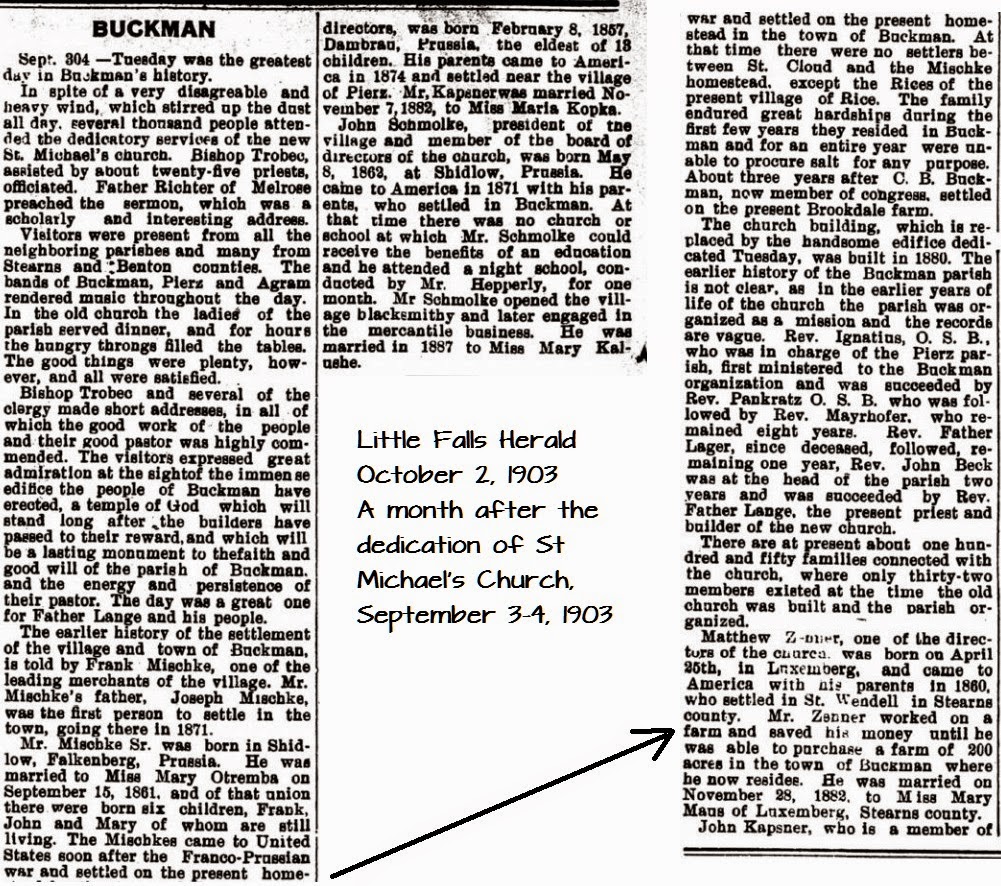
Here's an article that was published in the Buckman News column of the LFH a whole month after St Michael's church was dedicated.  There are some interesting facts in the article, as well as some major goofs.  There'd been a wonderful front page article the month before, but evidently some of the "local color" was left out.  If that pissed people off, this article didn't do much to make up for it.
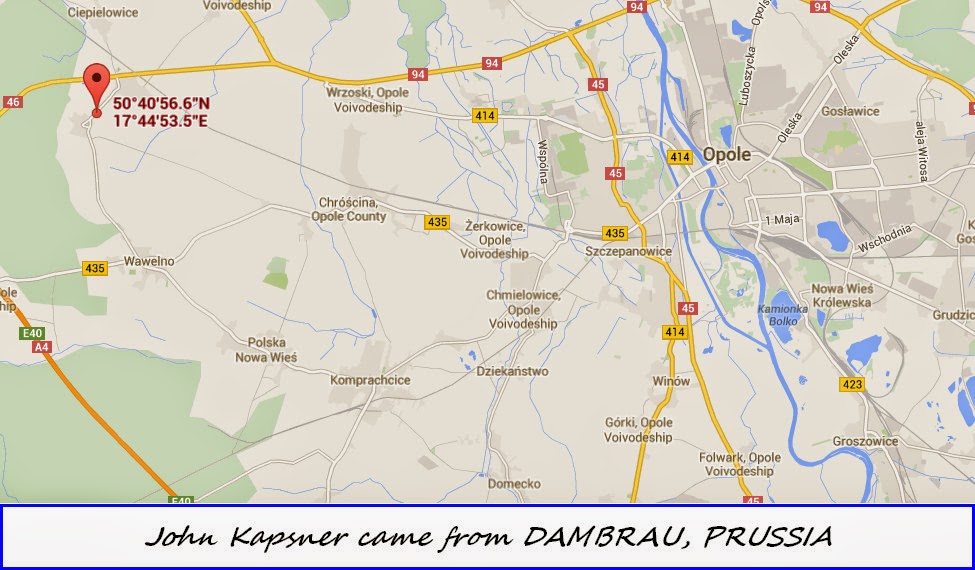
BUT, there are interesting incidentals listed, too.  For instance, there are the origins of four movers and shakers in town (Frank Mischke, Math Zenner, John Kapsner and John Schmolke), and the fact that three of the four came from the same area the Otrembas came from (within 6 miles of Opole, Poland). Also, look who con-celebrated the mass at the dedication:  Bishop Trobec, of course, and about twenty five priests showed up to help, not to mention three local bands.  A priest we've mentioned before,  Fr. Bernard Richter, gave the sermon, so we know he did have an actual connection to St Michael's (see previous post, for one ☺).  I imagine there were another couple dozen townsfolk who "should have been mentioned"...
BTW, I corrected many of the typos and wrong info, but you can click the article to read it yourself, or go to the original copy on the Library of Congress website:

BUCKMAN

"Sept 304--Tuesday was the greatest day in Buckman's history.
In spite of a very disagreeable and
heavy wind, which stirred up the dust
all day, several thousand people atten-­
ded the dedicatory services of the new
St. Michael's church. Bishop Trobec,
assisted by about twenty-five priests,
officiated. Father Richter of Melrose
preached the sermon, which was a
 scholarly and interesting address.

Visitors were present from all the
neighboring parishes and many from
Stearns and Benton counties. The
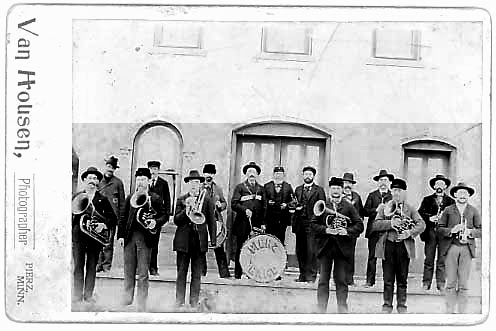
bands of Buckman, Pierz and Agram
rendered music throughout the day.
In the old church the ladies of the
parish served dinner, and for hours
the hungry throngs filled the tables.
The good things were plenty, how­
ever, and all were satisfied.

Bishop Trobec and several of the
clergy made short addresses, in all of
which the good work of the people
and their good pastor was highly com­
mended. The visitors expressed great
admiration at the sight of the immense
edifice the people of Buckman have
erected, a temple of God which will
stand long after the builders have
passed to their reward, and which will
be a lasting monument to the faith and
good will of the parish of Buckman,
and the energy and persistence of
their pastor. The day was a great one
for Father Lange and his people.

The earlier history of the settlement
of the village and town of Buckman,
is told by Frank Mischke, one of the
leading merchants of the village. Mr.
Mischke's father, Joseph Mischke,
was the first person to settle in the
town, going there in 1871.
Mr. Mischke Sr. was born in Shidlow, 
Falkenberg, Prussia. He was
married to Miss Mary Otremba on
September 15, 1861, and of that union
there were born six children, Frank,
John and Mary of whom are still
living. The Mischkes came to United
States soon after the Franco-Prussian
war and settled on the present home­
stead in the town of Buckman. At
that time there were no settlers be­
tween St. Cloud and the Mischke
homestead, except the Rices of the
present village of Rice. The family
endured great hardships during the
first few years they resided in Buckman
and for an entire year were un­able
to procure salt for any purpose.
About three years after C. B. Buckman, 
now member of congress, settled
on the present Brookdale farm.
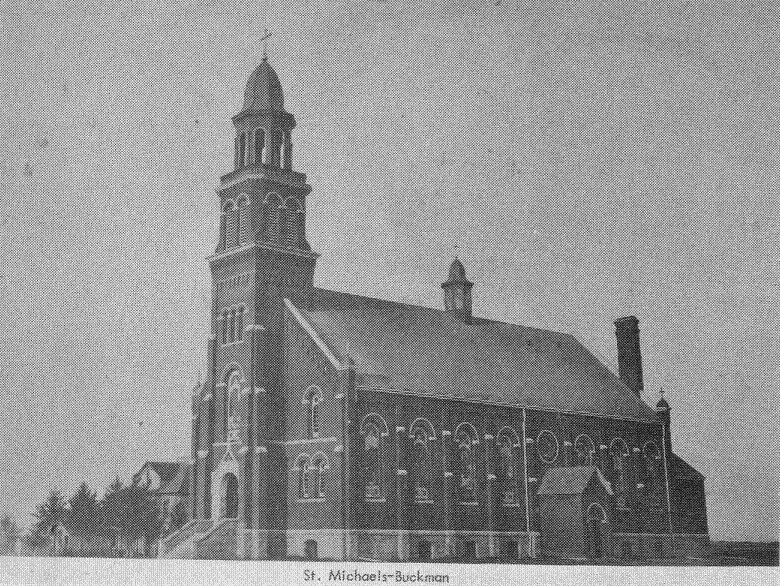
The church building, which is re­
placed by the handsome edifice dedi­
cated Tuesday, was built in 1880. The
earlier history of the Buckman parish
is not clear, as in the earlier years of
life of the church the parish was or­
ganized as a mission and the records
are vague. Rev. Ignatius, O. S. B.,
who was in charge of the Pierz par­
ish, first ministered to the Buckman
organization and was succeeded by
Rev. Pankratz O. S. B. who was fol­
lowed by Rev. Maryhofer, who re­
mained eight years. Rev. Father
Lager, since deceased, followed, re­
maining one year, Rev. John Beck
was at the head of the parish two
years and was succeeded by Rev.
Father Lange, the present priest and
builder of the new church.
There are at present about one hun­
dred and fifty families connected with
the church, where only thirty-two
members existed at the time the old
church was built and the parish or­
ganized.
Matthew Zenner, one of the direc­tors
 of the church, was born on April
25th, [1857] in Luxembourg, and came to
America with his parents in 1860,
who settled in St. Wendell in Stearns
county. Mr. Zenner worked on a
farm and saved his money until he
was able to purchase a farm of 200
acres in the town of Buckman where
he now resides. He was married on
November 28, 1882, to Miss Mary
Maus of Luxemberg, Stearns county.
John Kapsner, who is a member of the
directors, was born February 8, 1857, in
Dambrau, Prussia, the eldest of 18
children. His parents came to America­
 in 1874 and settled near the village
of Pierz. Mr. Kapsner was married ­
November 7, 1882, to Miss Maria Kopka.

John Schmolke, president of the
village and member of the board of
directors of the church, was born May
8, 1863, at Shidlow, Prussia. He
came to America in 1871 with his parents,
who settled in Buckman. At
that time there was no church or
school at which Mr. Schmolke could
receive the benefits of an education
and he attended a night school, con­
ducted by Mr. Hepperly, for one 
month. Mr Schmolke opened the village 
blacksmithy and later engaged in
the mercantile business. He was 
married in 1887 to Miss Mary Kalnabe" [actually, Hedwig Peschel].

Monday, September 30, 2013

Travel, Blow snakes and Karo syrup


The Andersons probably went by way of St Cloud, making the trip 132 miles instead of 103 miles and an hour and 49 minutes now.   


 The western hognose snake (puff adder or blow snake) is primarily diurnal. If threatened (or perceiving a threat), it may flatten its neck (much like a cobra), hiss, and make mock strikes...Although it is more common that they will flatten their heads out, some individuals may puff up, filling their throats with air. This is more common with adolescent males.


Oh yeah, I was sure this was a pull-yer-leg story, but just for fun I googled "blow snake"--and, wow, there really is/WAS such a thing.  (With snakes, you react first, talk later).  There may have been a small benefit in seeing one if it meant your friends plying you with liquor as a cure, too. "...the snake blew it's poison into his face and poisoned him" was enough, even if there was no poison.


 Wonder if the side track in Elk River ever materialized?  Who knew there were mineral springs there? Stranger things have happened; it was an age of possibilities and mineral water was mineral water, right?

 Wow, just think--Paul's wife Mary (Otremba) Hesch came here when she was 12, and now, at 57, she went to see the big ships.  Course, this may have had something to do with Math & Ted talking about going to Europe (they did the following spring), and maybe Mary wanted to see for herself whether or not the were safer now.


What an odd ad, huh?  Corn syrup was better than honey?  But maybe honey was considered poor man's sugar, where Karo was manufactured.  

This next article blew us away.  We thought "Live long and prosper" was Star Trek...but no--actually, it was used to wish a happy life to newlyweds too.
(Everything old, etc)

Saturday, August 10, 2013

St. Michael's Catholic Church, Buckman, Minnesota, 1903

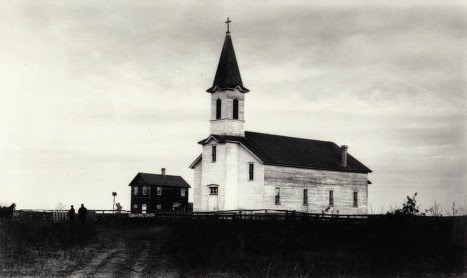
When the settlers in what became Buckman, Mn. decided to incorporate as a village, St Michael's Church was a big part of signing the papers and making it legal.  That was, coincidentally, in 1903, just like the date in the headline, see?  A beautiful new church in an established town benefitted both.  Anyway, here's the front page article in the Little Falls Herald of September 4, 1903...but don't bother trying to enlarge it.  If you're really interested, click HERE for the page at the Library of Congress.  However, if you're only interested enough to read that article, scroll down.  The pertinent article was called "New Buckman Church", below.


Why September 29th, you ask?  Because that's the feast day of St Michael the Archangel (and in fact, for years, the bazaar was held on that date, no matter the day of the week).  In 1903, the next issue of the LF Herald was published on October 2, and the entire Bucknam News column was dedicated to the new church, and oddly, bios of three prominent church "directors".

Friday, July 26, 2013

Wonderful History Overload ☺

There are times when other stuff in our lives takes precedence over Hesch history (I know, how is that possible?!) but the SEARCH for history is ongoing, and sometimes it even falls in our laps.  Then too, we'll find 3-4 things at a time because one thing leads to another....such riches!
  
TG for the internet, bookmarks, and for people who wrote stuff down!

One cool discovery from Larry this week is a list (with pics) of Past and Present Minnesota Railroad Stations by county.  Morrison has 10 pictures, and I think we can add to their set with pics we found in the Morrison Co Atlases.
See if you can discover an inaccuracy there...☺
Another is this website about George Lawrence, who took pictures with a camera rigged on kites.  He took a few photos of St Cloud in 1900 or so.  Most are here on the Library of Congress website, along with 260+ other historic aerial pics he took.
"Zion Industries at Shiloh Tabernacle, July 1904, Zion City, Ill."
Can you imagine the thrill of lining up like this, in 1904, and facing a camera suspended from a kite?  W
e've posted about Zion City and A.J. Dowie before, so this pic caught my eye ☺.  Damn, in fact, they ALL do, but I have a post to write.  If you find good ones, leave a comment, ok?  The pics are numbered.

Lessee, what else? OH, this site where Larry found the original plat map of the village of Buckman, and the names of the residents who wanted to incorporate it.  I intend to transcribe what John Schmolke wrote here, so check back, ok?  

A cool sidelight Larry discovered on this plat map is the name of the artist who copied it, one George Harting:
(the above from Morrison Co Influentials)

 Lloyd Harting. Artist. Born in Little Falls, Minnesota, in 1901, Lloyd Harting was one of the Art Directors on the Disney cartoon, Bambi. Lloyd worked for the advertising agency, Brown & Bigelow, and for 20th Century Fox Film Co. Studio. Brother of George Harting.

Thursday, June 20, 2013

Nicholas Sand & Sophia Dehler

A clipping from the Minnesota Journal published on August 4th, 1903--an obituary of Sophia (Dehler) Sand.  (The red edge means Larry found it, for sure ☺).  I've had it in my files for ages and only re-discovered it this week.  Did you know that another John Dehler lived in LeSauk (later, Sartell)?  This Nicholas  was Mike Sand's younger brother (both born in Luxembourg).  After Sophie died, he   married Magdalena Brodie, who went on to adopt 2 orphan train kids.  The link tells that story ☺.


LEFT A LARGE FAMILY
_________
Funeral at Sauk Rapids of Mrs. Nicholas Sand.
SAUK RAPIDS, MINN.--Mrs Nicholas Sand died Saturday evening, aged 43 years.  Besides a husband, nine children are left.  She was a member of the Degree of Honor lodge, and daughter of Mr and Mrs John Dehler of LeSauk, wealthy farmers of that section.  The funeral took place yesterday from the cathedral.

Notes:  The cathedral would have been Immaculate Conception, the German church, in St Cloud....The "Degree of Honor Protective Association began in 1886 as the Ladies Auxiliary of the Ancient Order of United Workmen. Membership was originally comprised of wives, daughters, mothers and sisters of the AOUW. Their purpose was to provide fellowship for the women, and also support the AOUW."  The nine kids were Odell*, Sylvester, Alfred, Francis, George, Robert, Victoria, Alma and Gertrude.    (* see clarification in the comments-- Thanks, Mary!)

 I suspect the Sand family wasn't as important in the community as the Dehlers were.  

Tuesday, April 24, 2012

"So, did you ever find JP Sand's grave?"

Why yes, yes I did--thanks for asking!

Calvary Cemetery in Little Falls is east of the river on the north end of town and seems to be a mix of pioneer families' members.  It seems to be a public cemetery with old graves as well as fairly new ones.  Maybe Little Falls had a north and south division too (like Pierz did) since Oak Hill Cemetery is also public but it's south of town.  I'm just guessing here tho.

In the front west corner of the cemetery I found him, by just walking around and reading the oldest looking stones.  The monument says:
"JNO. P. SAND
CO. G
11 MINN. INF."


If you don't recall his story, check this post from February.  Either he was proudest of his service in the war between the states or burial-and-a-tombstone was a veterans' benefit.  He enlisted in 1864 and spent 10 months as a soldier when he was 16-17.
According to this page from the 1890 census... (evidently, military records were stored elsewhere and survived the fire that destroyed the 1890 Federal census)...JP had a hearing loss from his service in the war.  The job of deputy sheriff would have been offered to a vet before someone who hadn't served, so that may be how JP got into law enforcement.  Again, that's just a guess.
I'd really like to know if any of his kids had kids, and if they realize who he was...

Friday, October 14, 2011

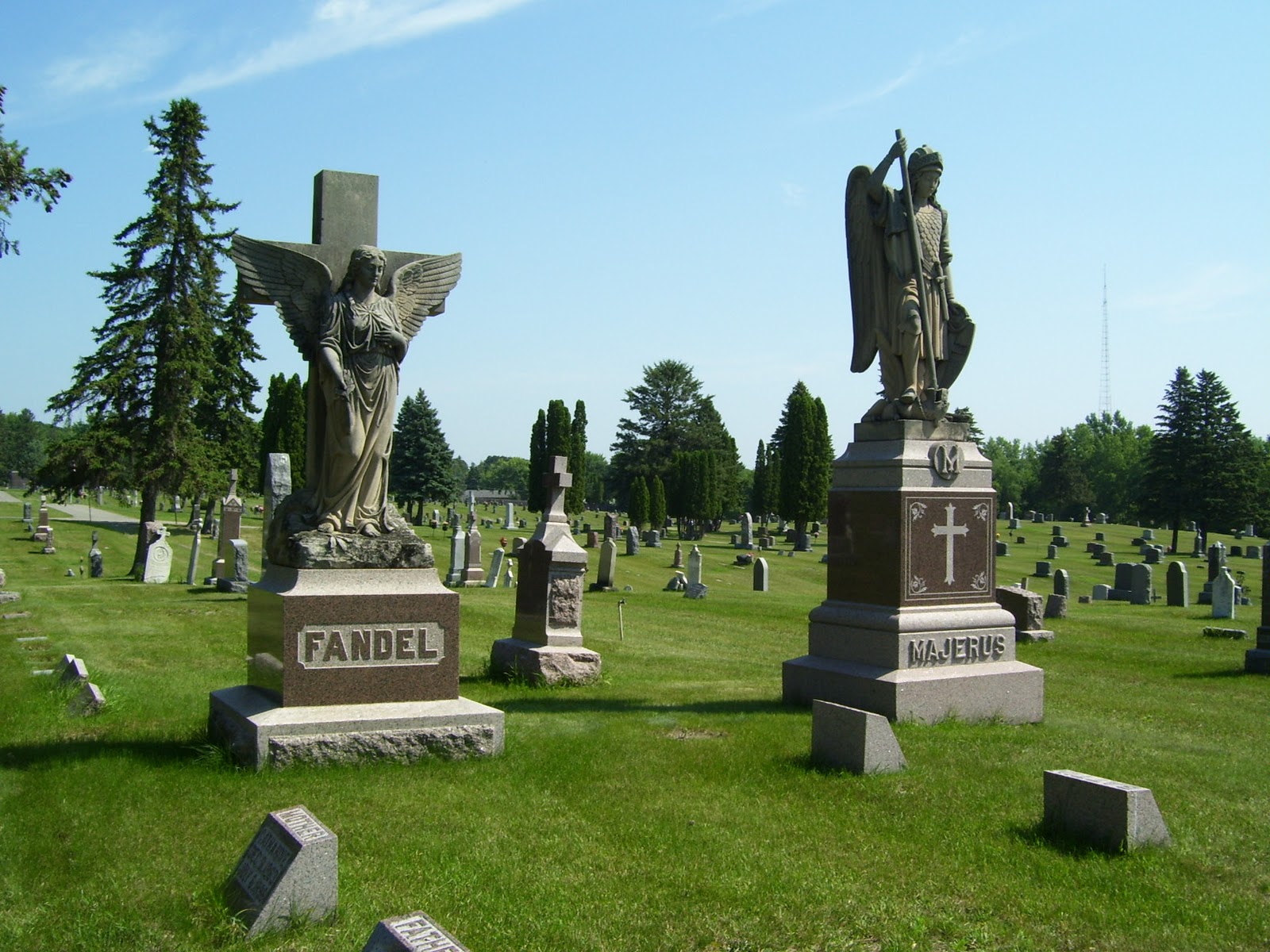
Who was Michael Majerus?

As I read Horst Hanneken's book about Buckman (see the sidebar to order), I'm amazed by all the interesting or obscure facts he's included.  For instance, when the new St Michael's Church was dedicated in 1903, the list of who donated furnishings included Frank Otremba (Statue of St Raphael), Mike Sand (statue of the BVM), Mrs. Paul Hesch (the sanctuary lamp and the St Anthony statue).  The statue of St Aloysius was donated by " all the  boys bearing his name" ☺...and the unusual statue of St Michael, above the main altar, was donated by a Luxemburger named Michael, probably a friend of Mike Sand, who happened to live in St Cloud.  That was Michael Majerus.


"So?"  (I heard you!)


Well, I recognized the name partly because of trips to Calvary Cemetery in St Cloud as a Find a Grave volunteer.  95% of the headstones there are 'normal' size, like those in the Buckman cemetery, but there are a few statues on prominent graves, one of which could be our statue's sterner, buffer, more colorless brother.  There he is, treading on his own dragon, over the MAJERUS family plot.


I suspect Mike Majerus heard the story of how the church was named from our Luxemburger great grandfather, Mike Sand: The naming rights were given to the highest bid, which was $65.00, contributed by Michael Osterich and Michael Sand of Buckman.  How could Michael Majerus resist?

BTW, here's a bonus St Michael's fact: The large bell in the steeple was baptized Catherine, after Mrs. Anton Otremba (our great grandmothers' parents).  Her husband had donated the bell for the original church in 1881, and 20 years later, she donated the second bell.  They both 
still ring from St Michael's belfry today.  Isn't that cool?

Sunday, June 7, 2009

Buckman, Incorporated

Looking at the names on the 1902 plat map of Buckman, and comparing them to names on the incorporation roster in 1903, I realized 1) how free and loose they were with spelling those names, and 2) how familiar most of the names still are.
Funny, I see only one couple there, the Mischkes, but which Mischkes? You'd think that notary would have KNOWN them...lol