This branch of the Austrian Hesch family is descended from Johann Hesch and his wife Marya (Schlinz) Hesch, who came to America from Oberschlagles, Bohemia with three sons: Paul, Mathias, and Anton. +++Johann & Marya settled in Buffalo County, Wisconsin but moved to Pierz, Mn in about 1885. .+++Mathias settled in Waumandee, Wisconsin and moved to Pierz in 1911. +++Anton never married but farmed with his dad in Agram Township, where he died in 1911.+++And Paul, my great grandfather, settled five miles away, in Buckman, Minnesota. He died there in 1900.

: : : : : : : : : : : :
Showing posts with label Mystery. Show all posts

Wednesday, June 3, 2015

St Mary's Grade School Mystery

This is St Cloud Minnesota history, so if you've never been here, you can skip this post, guilt-free ☺ :

Funny how something can stick in your craw for years, a puzzle that's just niggling there, waiting to be figured out...and suddenly, there's a rainy day in June that seems perfect for illustrating the problem to see if any of you readers have an answer or explanation ☺.  If you do, leave a comment, ok?


Ok, here are two postcards picturing Immaculate Conception church (the German Church) and St Mary's school as they were between 1896 (when the school was built) and 1920 (when the church burned down).  These buildings stood on west St Germain Street at the 900 block.  We know the street car tracks turned north on 9th right in front of the church (enlarge the left pic), and that the church property blocked 9th going south from there, shown on the map.
 This 1896 map fragment shows the school and church on the north shore of Lake George, and wow, both buildings look to be far back from the street, don't they...but the photo postcards have them flush with St Germain.  How can that be?  The school is still there, and if you approach from the walkway beside the current church, the school is indeed behind an office building to its north.
Here's the satellite view, and a few 2015 street view pics.
(Red vehicle above the R)
See the red vehicle (middle bottom of the satellite pic)?
This would be the view from there, looking north/northeast.

(There was obviously an addition built on the south face of the original school building--it doesn't match the mansard roof style at all, but the brick color matches). 
So, my burning question is: how come the school is now an entire office building south of where it was originally??
A little farther east, still looking north.
This view is from approximately the same place as the first pic up there--see the school
roof line behind the red brick St Mary's Building? 
LOL...I've tried for an hour to grab the outline from the first postcard to superimpose on this view, but DAMN, Paint.net isn't cooperating.  
Here's where your imagination comes in.
Shortly after I clicked "Publish", Larry sent these two pertinent vids!
They're quite interesting even if they don't answer the burning Q.  

and

Friday, November 14, 2014

A mystery photo


A photo that couldn't have come from the Morrison Co Atlases because it says 1995 (my copies are earlier than that).  I'm hoping that someone will recognize Clara Sand or Adeline Sand and fill us in on how they fit ☺.  

Monday, January 20, 2014

The Omega/rainbow symbol mystery

Here's a symbol used in the land owners' books in Bohemia.  This one's from 1694, and we found it in the 1700s too...not so much after 1800.  Out of curiosity, I wrote to SRA Trebon and asked if they knew what it meant.  No one did.
Sometimes, there was only one arch, sometimes two, sometimes three.  This one was the fanciest one I found.  
We see it as the last letter of the Greek alphabet (liturgically, "the alpha and the omega", the beginning and ending), so maybe it signaled the end of something.  But then, why the difference in the number of arches? 

It seems like they used the 'rainbow' symbol early on, or perhaps it was that particular scribe's peccadillo.  The pages below are from 1760 and they're all single omega signs.  No, it doesn't stand for someone's death, as that's what the little cross meant (second circle, right).  Might it have mean a debt, paid back, or a change of houses, or equipment loaned or sold to the serf?  
It had to be something fairly common, but significant enough that it made a difference to the landowner. 
Can YOU think of anything?  Brainstorming works, ya know--leave a comment ☺.
Thanks!
 

Thursday, January 17, 2013

"We're taking the mystery out of Hesch history" ☺


 There really was a man in Pierz back then named John Heach!
THIS is truly amazing:  I went to bed the other night mostly convinced that John Heach was a figment of someone's imagination at the Pierz Journal...but Larry decided to check further.  He thought about reasons a man would just show up in a small town and stay (hide ?) there for the rest of his life.  He had no relatives, he said, and his friends seemed to be a select few people in Pierz.  He became a "character" in town, an eccentric old guy who did odd jobs for a bit of cash.  We think he probably hung out at the Journal office, so the editor realized that John was smart and educated.  Evidently, John didn't talk much about his life before Pierz, so when he was convinced to write his autobiography for the paper he disclosed all he wanted people to know.

(BTW, Larry had already found census records of John Heach in 1900 and 1910 in Pierz.  He was born January 30, 1828 and died in Pierz October 29th, 1915).

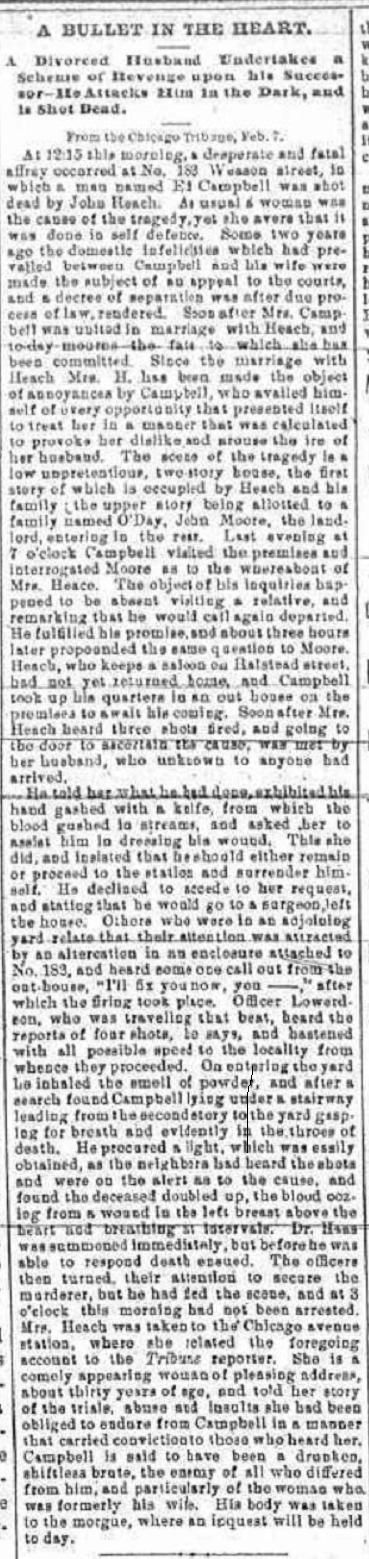
Larry thought John might have had something to hide--and look what he found--I've transcribed the newspaper column because it's hard to read, but it relates an incident in Chicago, in February 1876.  Yes, this man might not be Pierz' John Heach, but the timeline works, including time for him to have traveled the world, as he claimed, and a reason to 'lay low' for the rest of his life: 


A BULLET IN THE HEART.

A Divorced Husband Undertakes a Scheme of Revenge upon his Successor--He Attacks Him in the Dark, and is Shot Dead.

From the Chicago Tribune, Feb 7.

At 12:15 this morning a desperate and fatal affray occurred at No. 182 Wesson St, in which a man named Ed Campbell was shot dead by John Heach.  As usual a woman was the cause of the tragedy yet she avers that it was done in self defense.  Some two years ago the domestic _____ which had prevailed between Campbell and his wife were made the subject of an appeal to the courts, and a decree of separation was, after due process of law, rendered.  Soon after, Mrs Campbell was united in marriage with Heach, and today mourns the fate to which she has been committed.  Since the marriage with Heach, Mrs H   has been made the object of annoyance by Campbell, who availed himself of every opportunity that presented itself to treat her in a manner that was calculated to provoke her dislike and arouse the ire of her husband.  The scene of the tragedy is a low, unpretentious two-story house, the first story of which is occupied by Heach and his family, the upper story being allotted to a family names O'Day, John Moore, the landlord, entering in the rear.  Last evening at 7 o'clock Campbell visited the premises and interrogated Moore as to the whereabouts of Mrs. Heach.  The object of his inquiry happened to be absent visiting a relative, and remarking that he would call again, departed.  He fulfilled his promise and about three hours later propounded the same question to Moore.  Heach, who keeps a saloon on Ralstead street had not yet returned home, and Campbell took up his quarters in an outhouse on the premises to await his coming.  Soon after Mrs Heach heard three shots fired, and going to the door to ascertain the cause was met by her husband who, unknown to anyone, had arrived.
He told her what he had done, exhibited his hand gashed with a knife, from which the blood gushed in streams, and asked her to asist him in dressing his wound.  This she did, and indicated that he should either remain or proceed to the station and surrender himself.  He declined to accede to her request, and stating that he would go to a surgeon, left the house.  Others who were in an adjoining yard related that their attention was attracted by an altercation in an enclosure attached to No 183 and heard someone call out from the outhouse, "I'll fix you now, you ___", after which the firing took place.  Officer Lowardson, who was traveling that beat, heard the reports of four shots, he says, and hastened with all possible speed to the locality from whence they proceeded. On entering the yard, he inhaled the smell of powder, and after a search found Campbell lying under a stairway leading from the second story to the yard gasping for breath and evidently in the throes of death. He procured a light which was easily obtained, as the neighbors had heard the shots and were on the alert as to the cause, and found the deceased doubled up, the blood oozing from a wound in the left breast above the heart and breathing at intervals.  Dr Haas was summoned immediately but before he was able to respond death ensued.  The officers then turned their attention to secate the murderer but he had fled the scene, and at 3 o'clock this morning had not been arrested.  Mrs Heach was taken to the Chicago avenue station, where she related the foregoing account to the Tribune reporter.  She is a comely appearing woman of pleasing address, about thirty years of age, and told her story of the trials, abuse and insults she had been obliged to endure in a manner that carried conviction to those who heard her.  Campbell is said to have been a drunken, shiftless brute, the enemy of all who differed from him, and particularly of the woman who was his former wife.  His body was taken to the morgue, where an inquest will be held today.
Fulton NY Register, February 7, 1876
 A month later:
Incredibly, different professions around the country kept records of their trade in printed volumes that are still around--this time it's the Locomotive Engineers Journal, honest.  The man expelled from the brotherhood in the listing below might not be our man in Pierz, but he was certainly the same dude from the above article. Now we know he was trained to run a locomotive....

 Pretty cool, huh?  I always hope some relative of the people we spotlight here will google their name and realize that THIS was great-grandpa!
 Added October, 2013:
The plot thickens:
  Look at this list of granted divorces Larry found..."Matilda Heach from John H Heach, for desertion" --Chicago Tribune,  November 3, 1889.  Does it fit John's bio?  The shooting was in Chicago in 1876, and if he left town, he couldn't have become a train engineer later unless he owned another saloon, still later...AND married a woman named Matilda.  (The woman in Chicago was "Carrie", I believe, and she testified that they were never married).

If he was in Little Falls and Pierz by 1885, then Matilda had every right to claim desertion.

Tuesday, January 15, 2013

Who was John Heach?

This afternoon, Larry showed me a GREAT customized search engine he came up with to find key words on Minnesota Reflections.  He suggested I try a name--any name--from those we've researched.  I tried Otremba, and found gobs of hits, of course. One, the July 31, 1913 issue, 
had this startling headline:


Wow, could it be a misprint?  Did they mean grandpa's brother John...or the John Hesch in Agram township?  I'd never heard of a family named Heach around Morrison county, but what do I know?  
As we read the entire column, written in first person, we were still unsure if this was a relative. What he described wasn't familiar, but then.... He was supposed to have lived around Pierz for 25 years and was "well known". Hmm, did we need to do lots more research?  

The next autobiographical installment was the next week, August 7, 1913.  The headline was the same, mid front page at the top.  This John was erudite, and descriptive.  He'd evidently traveled a lot, around the world even.  WHO was he?

It's worth it to go to Minnesota Reflections online and search the word HEACH.    After those first two columns, the name is mentioned here and there, and finally there's an small announcement in 1915, of his death, with a tribute printed the following week.  We're pretty sure he wasn't one of us, that it wasn't a mis-print...see what you think.

Monday, June 11, 2012

Steel Co?

Here's another pic from Shirley via her dad's trunk.  
You can see dad and mom in the middle, across the table...is that Math and Eileen flanking them?  And, where was this?  What was the Steel Company?

Larry and I thought it looks like one of those 1990s time-share dinners, an 'investment opportunity you can't pass up', or maybe like the initial Amway or Shaklee get-together...shudder.  
--Mom got dad into a shirt and tie even tho aunt Eileen wasn't so successful. This probably was somewhere in St Cloud, after we'd moved there in 1953 or so, wow, this may have been one of the occasions when Carol and Bev babysat for us.  Cool!
--Anyone know more about it?

Monday, April 2, 2012

Near-names

When Larry first succeeded in his effort to get me interested in Hesch genealogy, I remembered a pioneer cemetery south of the Janson farm.  When we lived in Buckman, that little cemetery was overgrown with bushes and weeds, but in the spring it was almost carpeted with naturalized iris.  It was eye-catching and was probably the reason I was aware of it.
When I made a point of stopping there 2-3 years ago, I was startled to find monuments with the name BESCH.  Was this a mistake?  Couldn't be--there were a few of them, not just one.  Since then, we've found other references to the Besch family, who settled near Dixville.  (I believe the person who was killed when the Buckman mill boiler exploded was a Besch).  But Besch is close to Hesch.
As Larry and I peruse lists, websites and books for Buckman names, we've been struck by how many other 'near-names' there were in our little area.  They were different by one or two letters and by pronunciation...I wonder if this is a unique Morrison thing?
Poster--Poser
Mischke--Motschke
Rausch--Rauch
Mueller--Miller (same fam)--Millner
Besch--Hesch
Boser--Poser
Kasper--Kapsner

Any others?  Or, any explanations?

Friday, January 13, 2012

Eulogius and Eligius...a eulogy ☺

As we've looked for relatives on ships lists, in church books, military records, passport and citizenship applications, censuses...anywhere they might be listed, I've frequently whined to Larry that EVERY FREAKIN GENERATION repeated the same names--John, Mary, Joseph, Agnes, Mathias, Elizabeth, Anton, Rosalia, Paul, Anna--and how hard it is to distinguish if we mean grandpa or brother, aunt or matriarch, ya know?  Still, pretty much every Paul Hesch from Bohemia is ours because of German naming traditions, too. A double edged sword.

So, when Larry asked if I knew of a relative named Eligius, I thought he was teasing.  As it turned out tho, we've had not one but TWO Elogii (at least) in the Polish part of the family.

Yes, there was a St Eulogius.  The link'll get you more information about him than you care to know.  His name means "blessing", and that's enough for parents to know, I suppose.

Larry'd found an Eligius (misspelled Elignis) Otremba in the 1920 Census from Mahnomen, Minnesota.  As much as I complained about similar ancestral names, this person had to be related because of his name.

His father was Frank J Otremba and his mother was Sarah M Bellefuielle, we believe.  (When she died in 1951, her death certificate says her parents were Jonas Bell...lle and Amelia Spry). (Yes, Bellefuielle was a family in Mahnomen, then.  Jonas Bellefuielle was listed in the 1905 Minnesota census as Indian, born in 1871 in Becker Co. Mn).

According to People Search online,
Eligius E Otremba was born in July, 1917 and died in Wyoming, MN in December 2005, at 88 years old.  I know Larry found his obit online, but for the life of me, it's not online now!


Okay, I can hear you saying that Eulogius isn't the same name as Eligius.  They're close, tho, and I suspect Eligius settled on a version he liked and ran with it.  A weird name needs to be tolerated, I know...☺
Oh, and Eligius' dad Frank J was the son of Joseph Otremba and Hedwig Holeva.  My family tree says Frank's wife was Mathilda B Otremba...not Sarah.  So hmm.  We'll wait for Larry on this one, since I know we found them later, without Frank , in Royalton.  (That was an Indians Census listing, so Frank wouldn't have been included, while Mathilda/Sarah and the kids would have been).
 Who was the other Eulogius, then?  The one named after the saint--son of Frederick Schmolke.  Fred evidently married twice, since this page says they'd been married 4 years, with 3 children, but the next page shows 4 more Schmolke children.


  What's particularly interesting about the name "Eulogius Schmolke" besides its challenging pronounceablity?  I found a message left in 2009 on an online Schmolke genealogy message board , about a family legend and an earlier Eulogius:

".... I have been doing some research into the family tree and it was my understanding that Eloguis was sent to Minnesota around 1918 with the purpose of buying some land, for the family to move to. The family never heard from him again.  My mother was Rose and my grandmother, Elizabeth Jendro lived with us until her death, in 1958. I am living in Canada now and would like any information you may have in regard to the Schmolke family and particularly any information on Elogius..."

See why the name stood out?  We're talking Larry + me + a mystery.  Stuff like this tickles us both WAY too much, but we've solved plenty of other conundrums here, right?  Stay tuned!

Wednesday, January 11, 2012

Who was Bernard Richter?

A quote from a book by Maurice Faust of Pierz, about St Michael's church in Buckman:
"Architecture of the church is beautiful and unique in many ways.  Many of the furnishings are truly from another world.  A 40 X 90 foot oil painting [actually 4X9 feet] of St Michael was procured from Bernard Richter in St. Annaberg, Schleisen, Germany.  The Sacred Heart statue came from the Tyrol area in Austria.  The fourteen highly detailed Stations of the Cross are carved from wood and incredibly beautiful".
Last May, when we discovered that mention of the person responsible for the painting of St Michael in the church in Buckman, Minnesota, we figured  'Bernard Richter' was the artist.  Sure, Bernard Richter was probably a relatively common name in German speaking parts of Europe.  Richter means judge, so whenever we encountered the word in an old German book, we couldn't tell if it referred to a Herr Richter or a local judge.
Anyway, our unbelievably SKILLED researcher Larry tried seeing if this person was mentioned either here in the US or there, in Poland/Germany/Bohemia--at that time, or since.

He found Bernard Richter on Find-a-Grave.com, buried in Melrose, Minnesota in the priests section!


The following is from History of Stearns County Minnesota, written by William Bell Mitchell in 1915.
"Right Rev. Monsignor Bernard Richter, of Melrose, was born in the Province of Westphalia, Prussia, Germany, September 28, 1863, and after attending the common schools passed through the high school into the University of Muenster. 

In December, 1884, he came to America, and continued his studies at St. Francis' Seminary, near Milwaukee, Wis. Here he was ordained to the priesthood, June 24, 1887. His first parish was at White Lake, South Dakota. 

His pious devotion and energetic work attracted the attention of the Right Rev. Bishop Otto Zardetti who made him pastor of the Cathedral at St. Cloud. 

On June 7, 1894, he came to Melrose as pastor of the Church of St. Boniface. His work here has been notable, and has resulted, by the grace of God, in the largest Catholic Church in Stearns county. The parish consists of 300 families, all Germans, and all devoted to the cause of the church. 

Under the direction of Father Richter, the magnificent church edifice was erected in 1899, at a cost including fixtures, of $75,000; the rectory in 1907 at a cost of $18,000 ; the convent in 1908 at a cost of about $7,000 ; and a sightly parochial school in 1910 at a cost of $50,000. 

In 1912, Father Richter was elevated by His Holiness, Pope Pius X, to the dignity of Domestic Prelate, thus investing him with the title of Right Reverend Monsignor". 
Right Rev Bernard Richter, OSB, died on December 18, 1921 and is buried in St. Boniface Cemetery (now St. Mary's Cemetery) in Melrose, MN.

Larry also discovered this passport application for Rev Bernard Richter in 1905.  He went to Europe and returned home after a couple months.  It's entirely possible that Rev Richter was asked by Polish parishioners in Buckman to purchase a painting of St Michael for the church....tho it seems like a painting would be a poor choice for display in a church, you know?

When Larry and I discuss the painting, we always go back to its anomalies...were they in-jokes by an artist who knew the Otrembas or Mischkes or Schmolkes?  Or were they a "dig" of some kind?  Whoever painted it was a classically skilled artist, so why mess with the symbolism like that?  

{Wow, sometimes we only need OTHER opinions: I mentioned the painting and odd object in Michael's hand to a client this morning--she suggested it might have been a scalp!  By the turn of the century, America's Indian wars were mostly over, but the aura of the "wild west" was well known in Europe.  Wow...We may never know for sure, but that might be IT}.

Monday, October 31, 2011

A new Sand pic, a new Sand mystery!

Woohoo! 


Ok, NOW this info is correct, thanks to the 'anonymous' comment above ☺


We heard from another Sand connection, namely Frank Sand's grand daughter Carolyn.  (Frank's daughter Amelia was Carolyn's mom, ferschtay?)


Frank is the baby on Louisa's lap in this WONDERFUL photo she sent:
Since Frank was born in May, 1896, then this is late summer that same year--say, September?  How odd that the eldest child was front and center, overshadowing everyone else, but Joe couldn't stand in back, I suppose.  He woulda looked like a telephone pole.
 Here's the same photo, with names, as near as we could discern.  There were 10 children in the Mike & Louisa Sand family, but look, there are 11 here (don't forget to count Joe ☺).
The girl on the right looks "Sand", and was maybe 11-12 years old...but she doesn't fit in their family; there are no gaps in the birth order.  Could she have been a fraternal twin to Angie, maybe?  But then, what happened to her?  
We mis-interpreted the year this photo (below) was taken.  Now, I realize it was later, when Frank was 3-4 years old (that's him between Pa and Ma).  Let's say it was summer, 1900, ok?
(Added for comparing purposes ☺)


MANY THANKS and WELCOME to CAROLYN and her SIBS!

By the way, this post is the 800th post on Hesch History--pretty amazing for a family with "no history"...lol

Saturday, October 29, 2011

A Trachowfsky Mystery

When you're working on your family history online, one thing that's maybe not top-of-mind is to re-check sources you've checked before...UNLESS you're Larry.  He periodically stuns me with additional info, like yesterday ☺:
(Backstory: Our great grandpa Paul had a brother named Mathias.  Mathias Hesch married Agnes Trachofsky in Waumandee, Wisconsin in August 1879 and they eventually moved to Pierz, Minnesota about 1910.  They're buried in Pierz).

Larry found a small article in the San Francisco Morning Call from the 12th of March, 1892 with two very familiar names mentioned--


Mrs Trachowfsky's Will
Elizabeth Trachowfsky died on the 2d inst., leaving an estate of $1683.33 in cash.  By a will of the 25th ult., she left everything to the executrix, Mrs Annie E Bullis, in trust to bury her, to expend $50 for masses for the repose of her soul, to pay all debts, to retain $50 as a mark of esteem and as a small recompense for her kindness and attendance, and deliver all the rest to the testatrix's sister, Mrs. Agnes Hesch of Waumandee, Wis.


Wow!  Agnes had a sister in San Francisco.  In 1892, Agnes was 39...and Elizabeth was 41.  Evidently, too, she was in California by herself (no relatives):


TRACHOWFSKY--In this city, March 2, 1892, Elizabeth Trachowfsky, a native of Bohemia, Germany, aged 41 years.
Friends and acquaintances are respectfully invited to attend the funeral THIS DAY (Friday) at 8:30 o'clock A.M. from the parlors of the United Undertakers 27 and 29 Fifth Street; thence to St Boniface Church, 123 Golden Gate Avenue, where a requiem high mass will be celebrated for the repose of her soul commencing at 9 o'clock A.M. Interment Holy Cross Cemetery.
Thinking about how a single female immigrant might have found her way across the ocean and the country, it's likely she worked for another family and traveled with them to wherever they were going.  Sadly, since she had no offspring, her story ended in 1892 (until now).
We couldn't find Trachowfsky or variations of it in the censuses, so we tracked the other person mentioned to see if anything seemed pertinent...and also, cuz we COULD, ya know? ☺
According to the 1900 census, Annie E Bullis was 4 years older than Elizabeth, and was the wife of Edward A Bullis.  They had 4 living children, two of whom were still at home.  Ed was retired from a career that had to do with the interment of deceased Ex-Union soldiers /maybe just part of his duties.  We found his name and comments in a book called "San Francisco municipal reports Fiscal year 1898-99, ending June 30, 1899" where Ed was identified as "Superintendant".   
...............................
New info, same afternoon:
COOL! Larry found Elizabeth listed in the San Francisco city directory in 1880, working as a domestic at 1104 Post.  Of course he looked-up that address: it was the home of George O and Margaret McMullin, grocers.  He found them in The Elite Directory for San Francisco and Oakland from 1879.  So, we know more about Elizabeth, but
...............................
  
As usual, new info brings more questions.  Now, when we go back to the church books in Bohemia from those years, maybe we'll find more than Thomas Trachofsky as Elizabeth's parents (Agnes's mom wasn't named in her birth account).  Also, since a brother named Alfred wasn't mentioned in the obit, was the man by that name in Pierz related...or was it just that her sister was closer to her?  
I'm hoping someone will google Trachowfsky/Trachowsky/Trachofsky and arrive here...and let us know.

Thursday, June 9, 2011

How do Posers fit in Hesch History?

A good part of the fun of family history blogging is that people contact us about who fits where or whats-the-connection.  It tickles me, for sure.  I always forward those emails to Larry so we can both relish being experts in at least one thing.


This week, Charlie Sand's grandaughter Kathryn forwarded an inquiry she got on Ancestry.com, asking about the POSER connection in our family.  Charlie was Grandma Lizzy (Sand) Hesch's younger brother, and their oldest brother, Joseph, married Antonia Elizabeth Poser.  They lived in Shaunavon, Saskatchewan, Cananda all their lives.


The inquiry has a really neat story attached. Keith, the gentleman who wrote, is not related, but....let him tell it:
"In the '70s, I lived in West Berlin, where my "Stammkneipe", the gasthaus/bar I frequented, was almost a small community...Christmas savings clubs, closed dances, etc.  Everyone was friends.  A fellow whom I remember as being a schoolteacher in his thirties, explained one day that he needed help to move some heavy furniture, and a few of us went to help.  He had inherited an apartment, with belongings, in the Kreuzberg district, and we ended up struggling down four flights of stairs with extremely heavy old oak furniture.  There was junk left lying in the apartment, and he gave me the cigar box with old pictures and postcards in it.  For the life of me, I can't remember the guy's name.  But I kept the box all these years.........The Posers lived at Kreuzberg Strasse 50, though there are other addresses in the Neukoeln district and in Tempelhof".
Wow--right away, this sounded like a Perfect Project for the family Super Sleuth Team ™.  I tried Anywho, online, and found 74 Posers in Minnesota, a few of whom live in Pierz.  I did a little calling, and hope to hear from their family genealogist on the weekend ☺.  We'll see if this Poser family came from Berlin.  The photos and postcards are c. WWI, and  could easily have belonged to a brother or first cousin who didn't emigrate, but stayed in Germany.
Keith said too "I would much prefer to give the items to descendants.  If I am unable to find the people I will probably donate the items to a museum in Germany dedicated to WWI memorabilia, as I think they would be most appreciated there".

Stay tuned--maybe we'll be instrumental in solving another COOL mystery!


Three days later: Nope, looks like it'll stay a mystery for Keith and for us:  Gary, the Poser family historian wrote:


Just to let you know, I heard back from my relatives in Germany and unfortunately there is no known relation to the Posers in Berlin .   Would have a been a fun connection!

Monday, February 21, 2011

de Vivaldi-The REST of the Story


It's interesting that we get all worked up, here in 2011, about fact-checking before an  article or story is published.  In 1892, 'close' was good enough.  Names might not be spelled consistently even in the very same article...like this, from the Milwaukee Sentinel (found on the Wisconsin Historical Society website. They have a fantastic collection!).
These two articles► appeared in May 1892. The first column there is basically the original one Larry found from the St Cloud Times, only fleshed out a little.  The second part is what I transcribed so it's easier to read, and so it's translatable:


(Milwaukee Sentinel May 30, 1892)


MME. DE COURCY'S SUIT
 __________________
Claim on Property Once Owned by Father De Vivaldi.
 _________________
ROMANTIC STORY ATTACHED TO A MILWAUKEE CASE.
 __________________
Interest in an Action Against A.W. Patton of Appleton Begun in the in the United States Circuit Court Here, Revived by the Return of Father De Vivaldi to This Country--Mme. De Courcy, his Daughter, Has Believed the Missionary-Diplomat Dead.
 __________________
The return of Father de Vivaldi to the United States, which was noted in the dispatch to the Sentinel some days ago may have an important bearing in a case which is now pending in the United States Court for the Eastern District of Wisconsin.  It is the suit of Corinne De Vivaldini de Courcy against A.W. Patton of Appleton, in which she claims the ownership of valuable land near that city, including a tract on which a paper mill is located.  Her claim is based on the descent of the property to her from Mrs. Meade of Green Bay.  The latter was Mme. de Courcy's mother, and according to the complaint was the original owner of the property claimed in the suit.
THEIR ROMANTIC MARRIAGE.
Mrs. Meade was the widow of a pioneer resident of Green Bay.  Some time about 1849, Father De Vivaldi, a Benedictine missionary, came to that city.  He fell in love with Mrs. Meade and his attachment was reciprocated.  In 1850 he renounced the priesthood and married the widow.  Mrs. Meade was a wealthy woman and she and her second husband acquired the title to a great deal of real estate in various parts of the country.  One child was born to the strangely-matched couple--a girl they named Corinne, and it is this daughter who is now the plaintiff in the lawsuits.The ex-priest prospered and soon after his marriage, he and his family removed to Nebraska.  He was appointed by President Lincoln minister to Brazil.  His wife and child accompanied him to South America and after the expiration of De Vivaldini's term of office the family made their home in Rio Janeiro.  Soon after the close of his term as minister, De Vivaldini separated from his wife and retired to a monastery.  Afterwards he was reinstated as a missionary.  For nearly twenty-five years the family was not heard of.  The name of De Vivaldini had nearly been forgotten, when about two years ago "the little girl Corinne," as she was known to the early settlers of Wisconsin, returned to the United States a woman and declared herself the heir to the estate of Father De Vivaldidi and his wife.  She had been married in Brazil to the Marquis de Courcy.  Much of the property claimed by Mme. de Courcy has passed into other hands and suits were brought to recover the land.  It was one of these actions which was begun against Mr. Patton.  Legal steps were also taken to recover property in Minneapolis and from the fact that she had his estates probated it is believed that Mme. de Courcy believed her father dead.  But little can be learned in regard to Father De Vivaldini's career after he left his wife, but a dispatch states that he has been acting as a missionary to the Indians of Patagonia.  The fact of his reappearance, however, gives an additional interest to the suits.  A motion in the case against Mr. Patton will be argued in the United States court here shortly, and it is possible Father De Vivaldini may visit Milwaukee at that time.
LOL...lots of mistakes beyond misspelled names and wrong dates.  "The little girl Corinne" would have been known to only 2-3 'early settlers' of Wisconsin since she was born in Kansas, not Wisconsin, or Nebraska. 

Still, the amazing re-appearance of Francis de Vivaldi had to be stunning.  
Reading the articles Larry's found, we think Corinne never actually showed up in Minnesota or Wisconsin.  An "enterprising lawyer" from St Cloud tracked her down and convinced her to bring suit, thru him.  
How do we know she wasn't here?  Because her bio published in a Brazilian "Who's Who" of the time says

Corina Coaracy " was brilliant student and graduated with gold medal in 1874. To complete the education she received in college, she studied languages, literature, painting, music and song. Corina was endowed with a beautiful mezzo-soprano voice and for this reason was  frequently invited to participate in benefit concerts, many performed in promote the abolitionist campaign".   "In 1891 she returned to the United States, to address family concerns.....She was taken ill in New York and the medical advice she moved to southern country, where he died of cerebral embolism on March 23, 1892, in a village near New Orleans".
Mysteries still outstanding are whatever came of the lawsuits, and how and where did Father de Vivaldi die.
Wasn't this whole investigation COOL?

Friday, February 18, 2011

"You're still not skeptical enough"

Wow, do we ever have a great historical story for you!  It involves Ho-Chunk Indians, central Minnesota, Patagonia, the Civil War era Know Nothing party, Italians, newspapers, and Brazil, among other things.  There's deceit, the government and a married priest, and MYSTERY.
Woohoo.


First, lets begin with Patagonia. No, not the outdoor gear company, but the area of South America called Patagonia.

That would be Patagonia ►
☺ 

And ◄ Long Prairie, Minnesota--also integral to this story.  Not to mention St Cloud, in 1892.  


And since we're posting maps, the Green Bay area of Wisconsin is involved, as well as the eastern portion of Kansas.  

( Green Bay was the romantic high point of our story, and Menasha, Wisconsin (see it there?) was also mentioned in our research, so it's cool to realize where those towns are...)


Now KANSAS on the other hand--the town of Manhattan--is a big part of the story, and it gets even MORE exciting, promise!


Oh, and even THIS is part of the story...
...to be posted tomorrow!