This branch of the Austrian Hesch family is descended from Johann Hesch and his wife Marya (Schlinz) Hesch, who came to America from Oberschlagles, Bohemia with three sons: Paul, Mathias, and Anton. +++Johann & Marya settled in Buffalo County, Wisconsin but moved to Pierz, Mn in about 1885. .+++Mathias settled in Waumandee, Wisconsin and moved to Pierz in 1911. +++Anton never married but farmed with his dad in Agram Township, where he died in 1911.+++And Paul, my great grandfather, settled five miles away, in Buckman, Minnesota. He died there in 1900.

: : : : : : : : : : : :
Showing posts with label 1940. Show all posts

Thursday, May 28, 2015

Katie Hesch marries Blaise Sufka


It was September 24, 1940, and yes, that's Mike (dad) as bestman.  The bridesmaid was Uncle Blaise's sister Betty. They all look so young....

(Thanks for the info, Butch!)

Saturday, February 9, 2013

Probably the last shot of the 1940 Pierz war games

 Remember these photos of local boys pretending to "help" soldiers?  It was a charming human interest story from Pierz, Minnesota, in August, 1940.  When we first posted em, I mused about WHO the kids were, and through the Morrison County Historical Society blog, we found out the identity of one of em!  See the blonde kid?    He was Melvin Grell, whose dad was Joseph Grell, a long time merchant in town.  Click each pic to enlarge, ok?
We'll do a post about Joe soon, so you can stop worrying about it.


When we were researching the pics late in 2010, we didn't recognize many Pierz names.  The Pierz Journals weren't online yet then, so even if we'd known the kids' names (shoulder shrug) it wouldn't have made much difference. However, when we get going on a story....well, you know how it is...
Anyway, the pics are only tangentially what this post's about...read on:

The war games held in Morrison Co that summer simply couldn't happen now.  The Red and Blue armies made up of the fourth army from Minnesota, Kansas and Nebraska, started near Mille Lacs Lake.  The object was to "capture" Camp Ripley (about 40 miles away).  Farmers gave permission (some reluctantly) for the army's use of their land, and towns were warned. Maneuvers were six days long, and then both armies went home.  
  
Two months later, in October, 1940, some kids east of Pierz found a bullet in the ditch across from their farm.  Boys being boys, they wanted to see what it could do.  They took it in the house to see if it'd fit in their dads' gun, but the shell was too big, so they went to the garage and put it in a vise.  Three brothers, ages 11, 9 and 7, plus a 30 year old neighbor and relative watched as the 11 year old hit the thing with a hammer and punch.  It exploded (even blanks have gun powder inside) and casing pieces hit the 9 year old in the right eye.  
When their parents came home an hour and a half later, Gerald was rushed to the hospital in Little Falls, where the doctor removed his eye.

We know all this cuz there are documents and newspaper articles online that our master researcher found.  In addition, Larry saved these articles that shed a lot more light on the political situation in Pierz then.  They're definitely worth a read!

Monday, July 18, 2011

Another great vintage map...

...which answers the burning question, "Where exactly did Buckman get electricity from in 1940?"
Oh man! Larry found a huge bunch of maps on the U.S. National Archives website.  I adore maps, ya know?  The specific map he directed me to was (no surprise) Morrison County, and it's gorgeous. 

Here's the map of Little Falls from that set, with sponsoring business cards around the edges.  It's a  glimpse of business in the county seat before WWII.  (Just think, dad would have been 27 that year, mom was 25 and working in the cities. They hadn't met yet.  All my grandparents were alive in 1940, and Buckman was a boom town, on it's way UP.  Pierz was still fighting over schools, and the second rectory dynamiting was 12 years in the future.  Prohibition was only a memory by 1940, and Math Hesch was busy writing the Buckman News for the Little Falls and Pierz papers.  Wow).
   Here's the map used by the census takers in 1940, tho no homes are marked, just roads and physical features.  Still, those features seem different from what we knew when we were kids.  Just look at all the school houses scattered every few miles...and how much land was swampy.  Check the Mississippi below Little Falls to see a mill that was still working on water power, in 1940.  Look where the railroads ran, and what river/stream drained which lake.  Can you find the Weiling or the Green Schoolhouse, or Vater, or Center Valley?  They were all going concerns then.

THIS is the map I want to draw your attention to, tho.  The two halves don't align like above.  It's ok, cuz I'm trying to highlight where Buckman's power came from, and that evidently, other towns didn't have it yet.  The little T's with a curved line between 'em indicated High Lines...probably a NEW term then, huh?  
There was a family story that mom's dad, Anton Janson, experimented early with electricity to power jobs around the farm (like silo filling, etc).  I was  skeptical, thinking WHY would MP&L run lines THERE (see the little red circle?), rather than other areas first?  But look!  They did, and the story has WAY more veracity now.
Thanks again, Larry ☺x3

Thursday, April 14, 2011

Back to Buckman in 1940

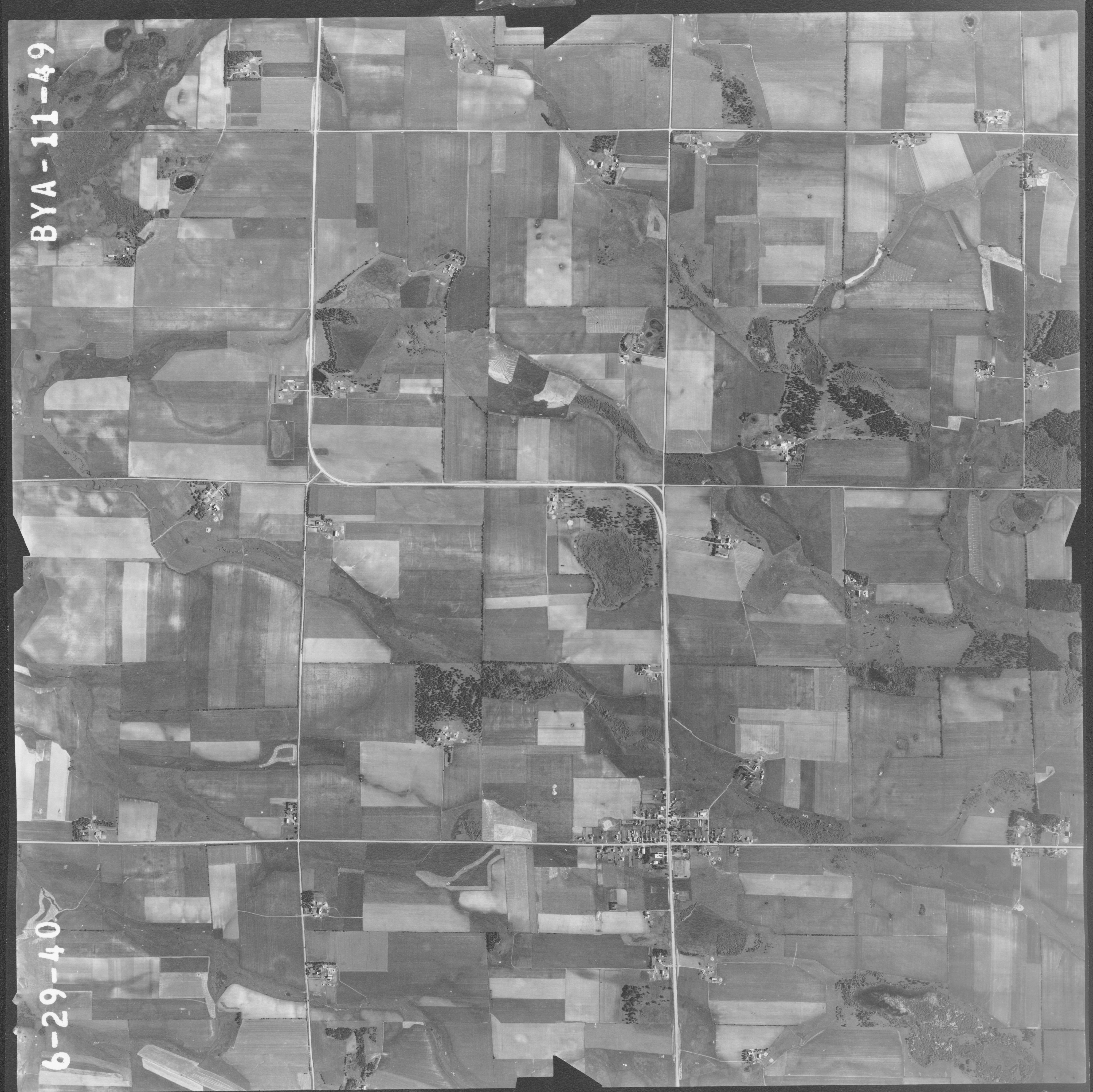
Damn, I love this photo!  It's about 9 square miles of the countryside around Buckman, Minnesota just before WWII, from the DNR.

I've often wondered where certain people lived--like Anton Otremba, for instance.  I know he homesteaded north of town, but which was his farm, and which was Buffalo Frank's?  Or John?

Anyway, I've numbered the farms starting with 1 in the upper left, working back and forth to 41.  I know 4-5 of them for sure:
22-Mischkes
25-Herolds
27-Math HESCH
36-Anton Janson
37-Gust Dehler (Jr)

And I believe #17 was the original CB Buckman farm, tho I don't know who lived there in 1940.

BTW, when you click the pic, it should enlarge to a nice big map.  If you know who lived where, please leave it in a comment, ok?

☺ Thanks!

Saturday, January 8, 2011

Now this is weird!

Larry checks ebay once in awhile just to see if there's something interesting available.  He checks under a few familiar key words, one being "Pierz"--and LOOK what came up yesterday!

This photo is much, much clearer--boy #2 is wearing glasses, and boy #3 is barefoot ☺.  You can see details that were fuzzy or smudged in the newspaper pics posted here last month.

WOW, wouldn't it be cool if one of those boys bought the original photo?  The auction closes January 12th and there are 3 bids on it so far (highest is $17.38).  Still if one of those kids is YOU or your dad, it'd be priceless.

Sunday, December 26, 2010

Reddy was Ready

It's interesting to remember that our history books made it seem like America was totally blind-sided by Japan's attack on Pearl Harbor in November 1941.

This ad ◄ was in the same newspaper in Kansas as the Pierz kids photo (August 1940) 15 months earlier...but of course THAT was war related prep, too.

I think there must have been a sense in the US that we hadn't been really prepared for World War One...or that we could have been much better prepared.  According to Wikipedia, so many men were killed in WWI "due largely to great technological advances in firepower without corresponding ones in mobility".  America was intent on preparation this time, since  WWI hadn't solved the problems that caused it, either.

(Besides, I still think wars are the "legal" way to test new weapons.  Think of the officers' reactions at the beginning of the first Gulf War--"Wow, it worked better than we ever expected it to!")

So, by 1940, the wording in this ad is belligerent without saying why--"our freedom" was being threatened, so Reddy Kilowatt was gearing up to provide more consistent power to Americans?  People understood even if it didn't actually make sense.

Monday, December 20, 2010

Remember this?


(It's snowing here.  The roads aren't too bad yet, but the prob with driving is keeping the windshield clear.  It's warm enough (16º) that the snow melts on the glass but the wipers smear it back into ice. Awk!   But I saw my Monday afternoon client early, so now I'm safely home and blogging ☺)......


Remember the AP wire service photo from THIS post  a few days ago?  I sent it to Mary at the Weyerhauser Museum in Little Falls to see if anyone knew who the local boys were.  In the meantime, Larry saw that the Library of Congress website has added more newspapers to its digitized collection.  Was that photo published in other cities around the country? Sure, it was, and the actual photographer was from the Minneapolis Journal.  Turns out the "candid" photo was nicely posed, while moms stood in the doorway of Hartmann's.  Isn't this COOL?  I see at least four adults on the left, and two more by the door, one holding a baby.  Even the reflection of the car in the window is interesting.  Is that a little sis between boys 2 and 3?

Good thing the photographer got them all to aim at the same thing.


(Above--from Minnesota Historical Society website).


::::::::::::::::::::::::::::::::::::::::

Additional info:  Here's Hartmanns store today, as seen on Google Earth.  Looks like the white house next door was there in 1940 as well.  


Below, Larry did a cutout of the boys and soldiers and put them on the sidewalk in 2010.  Kinda freaky, but kinda cool, too!


(If you check the Morrison County Historical Society blog, you'll see that Mary posted the photo as it appeared in the Little Falls Transcript in August 1940 too. Maybe we'll find out who the kids were after all!)

Saturday, December 18, 2010

Minneapolis Moline, Camp Ripley and the Jeep

It's amazing to follow a tangent that strikes us as interesting and to find even MORE:

Last week, the story about war games in Pierz in 1940 brought us to Camp Ripley.  It's a "background" place for Morrison County--we all know a few men who trained there over the years. It's "always" been there, along the river, home of the National Guard in Minnesota.

With that, Larry asked how far Pierz was from Camp Ripley...did I know the name Minneapolis Moline and did I know there was a connection between it, Camp Ripley, and the Jeep military vehicle?  (He's always a few pages ahead of me in the research book ☺).

 Well, I knew Minneapolis Moline (MM) made farm tractors...and ya know,  farm stuff.  Turns out that before the U.S. got into WWII, there was a sort of competition among manufacturers to build the newest kinds of military equipment.  One 'need' was a sort of all purpose vehicle.  That summer of 1940, MM had a prototype ready, and displayed it at Camp Ripley.  (No, you're right--it doesn't look anything like a Jeep.  More like a.... manure spreader?)

The MM-UTX Jeep
"The next version of the Jeep takes us to Camp Ripley, Minnesota, home of the 109th Ordnance Company, Minnesota National Guard. Captain Martin Schiska commanded the 109th, as well as being an employee of the Minneapolis Moline Power Implement Company, builder of farm tractors. In the mid 1930s, the Army was still using ancient, hulking 1917 Holt 5- ton tractors to pull its larger field pieces. Schiska, a World War I veteran, realized the need for new equipment and impressed this upon Minneapolis Moline. As early as 1938 (some sources say 1937) MM was building and testing prototype prime movers, and in August of 1940, during testing at Camp Ripley, Sergeant James T. O'Brien is quoted by several sources to have applied the name "Jeep" to the MM prime mover. In a letter to Minneapolis Moline dated March 31,1943, O'Brien explained how the name came about. "One evening," he wrote, "in a gathering of enlisted men, it was suggested that a short descriptive name be found for these vehicles, such names as 'alligator' and 'swamp rabbit.' I brought forth the name 'Jeep' as a result of reading Popeye in which Eugene the Jeep appears as a character, and the fact that these vehicles would go where you would least expect them to go. The name was unanimously accepted and subsequently painted on the vehicles, which have since become familiarly known." The MM Model UTX was a real piece of hardware. Basically a converted farm tractor, the MM Jeep featured four wheel drive and a 425cid, 70hp (at 1,275 rpm) six cylinder gasoline engine. It could pull a 5-ton 155mm howitzer at 28 mph, with occasional spurts up to 40 mph, and had a fording depth of over three feet. The MM Jeep prototypes came in open and closed cab models. Two of the four tested at Camp Ripley mounted .30 cal machine guns. All models featured a roller device in place of a front bumper, enabling it to cross large obstacles. Some also mounted winches. During testing at the Fourth Army maneuvers in August 1940, the MM Jeep was photographed climbing six feet up an oak tree. (The tree gave up at that point, and the tractor crushed it into matchsticks. So much for Treading Lightly!) The tractor was also said to have "walked" through a forest of 5inch trees. These photos appeared in the Army Times (Sept. 14, 1940) in an article entitled "Army Likes Jeep." The MM Jeep performed well in a succession of tests, but the Army's requirements seemed to change by the day. Before the UTX ever went into production, the evolution towards larger and larger field pieces and the requirement for a relatively high road speed ultimately overwhelmed the UTX's capacities. A total of six were built, and one survives in a private collection". 

Source

There's a lot more history of the actual Jeep at the link, but isn't it cool to know Minnesota played a part in it's development?

Oh, by the way, the cartoon Jeep ate only orchids--watch:

Saturday, December 11, 2010

War games in Pierz


In August 1940, the United States was not in the war in Europe, but we were certainly watching what was happening there, and we were preparing "just in case".
Sure, everybody who lives around Little Falls or spends time there knows the thuds in the distance are from Camp Ripley and the National Guard training going on there. But the training in 1940 was quite a bit different.  Read this article from the Lawrence, Kansas newspaper.  It explains better than I can....

Amazing that they were practicing maneuvers in and around local towns--"Stationed on Pierz sidewalks were 37 MN anti-tank guns and 50 caliber machine guns".  WHEW!  And, it was 1940 after all--some of the game used horses, while observation planes pretended to be bombers.

This story's fascinated Larry and me for months...lol  But since we don't know that any locals were involved, we just talk about it now and then--"Can you imagine an ARMY tearing past your farm and across your fields?"  And Larry found an account of some boys who found live ordnance in a ditch and proceeded to put it in dad's vise, and hit it with a hammer. Oops.

Anyway, the story's come back around because Larry found this wonderful photo in the Spokane (Washington) newspaper, via Google News.  It's August 15, 1940, and there are four Pierz boys "helping" three guardsmen.
The boys have their BB guns and cap pistols trained on the enemy, just like the soldiers.  It's an AP wire service photo that most likely was published around here.  But, maybe not.  Who knows?

I'm really curious to know if anyone recognizes the kids, or heard stories from relatives who were 10-12 that summer.


BTW, here's the full front page it appeared on.  Click to enlarge and see how neutral we were.

Friday, March 26, 2010

Center Valley in 1940

Remember the little place that Sue and I went to find last summer?  It was a potential village seven miles east of Pierz called Center Valley.  Her great grandparents, John and Ket (Mueller) Hesch, operated a store there around 1920.  We found only the foundations of a creamery and store, plus a few other odd buildings...in a pasture.  With an electric fence. 

WELL.  If you read the last post, you saw that Larry the wonder-researcher found a Minnesota DNR site with pictures taken from the air as early as 1940.  Yes, Center Valley was pictured, altho someone drew on the photo with a grease pencil, and circled the buildings in Center Valley.  But still.

 
Larry took the current aerial photo and faded it to the 1940 map--WAY COOL, huh??


(No, we didn't draw on the aerial map...someone did that in 1940).

Buckman Minnesota in 1940

WOW!  This morning before I went to work, Larry showed me an amazing (and frustratingly non-intuitive) website from Minnesota's Department of Natural Resources (DNR).  Evidently, beginning in 1930, chunks of the state were mapped from the air. 
Of course, we tried Morrison county--nada in 1930, but  YES!  in 1940...this is the whole section--find the jog in Highway 25 to orient yourself, ok?  (The link above takes you to this page).

Now, on the actual site, click on the place you want magnified (like the village of Buckman...lol), and you'll find this:
Isn't it just magnificent?  Some buildings we grew up with were there in 1940 (St Michaels, the Hall, the Creamery, Zenners) and MUCH has changed since then...but to look back like this is stunning. 
Dad was 27 and hadn't left Buckman for the Army yet, the city hall was being built, the school had no addition, and look at the tiny pine trees on the north side of the church lot.  And WOW--no ballpark! 
The photo was taken in the early morning (see the shadows on the highway?)

Does anyone know who owned the farm in the upper right corner? 

A HUGE thank you to Larry.  OMG, what would we know without HIM?