This branch of the Austrian Hesch family is descended from Johann Hesch and his wife Marya (Schlinz) Hesch, who came to America from Oberschlagles, Bohemia with three sons: Paul, Mathias, and Anton. +++Johann & Marya settled in Buffalo County, Wisconsin but moved to Pierz, Mn in about 1885. .+++Mathias settled in Waumandee, Wisconsin and moved to Pierz in 1911. +++Anton never married but farmed with his dad in Agram Township, where he died in 1911.+++And Paul, my great grandfather, settled five miles away, in Buckman, Minnesota. He died there in 1900.

: : : : : : : : : : : :
Showing posts sorted by relevance for query Heach. Sort by date Show all posts

Thursday, January 17, 2013

"We're taking the mystery out of Hesch history" ☺


 There really was a man in Pierz back then named John Heach!
THIS is truly amazing:  I went to bed the other night mostly convinced that John Heach was a figment of someone's imagination at the Pierz Journal...but Larry decided to check further.  He thought about reasons a man would just show up in a small town and stay (hide ?) there for the rest of his life.  He had no relatives, he said, and his friends seemed to be a select few people in Pierz.  He became a "character" in town, an eccentric old guy who did odd jobs for a bit of cash.  We think he probably hung out at the Journal office, so the editor realized that John was smart and educated.  Evidently, John didn't talk much about his life before Pierz, so when he was convinced to write his autobiography for the paper he disclosed all he wanted people to know.

(BTW, Larry had already found census records of John Heach in 1900 and 1910 in Pierz.  He was born January 30, 1828 and died in Pierz October 29th, 1915).

Larry thought John might have had something to hide--and look what he found--I've transcribed the newspaper column because it's hard to read, but it relates an incident in Chicago, in February 1876.  Yes, this man might not be Pierz' John Heach, but the timeline works, including time for him to have traveled the world, as he claimed, and a reason to 'lay low' for the rest of his life: 


A BULLET IN THE HEART.

A Divorced Husband Undertakes a Scheme of Revenge upon his Successor--He Attacks Him in the Dark, and is Shot Dead.

From the Chicago Tribune, Feb 7.
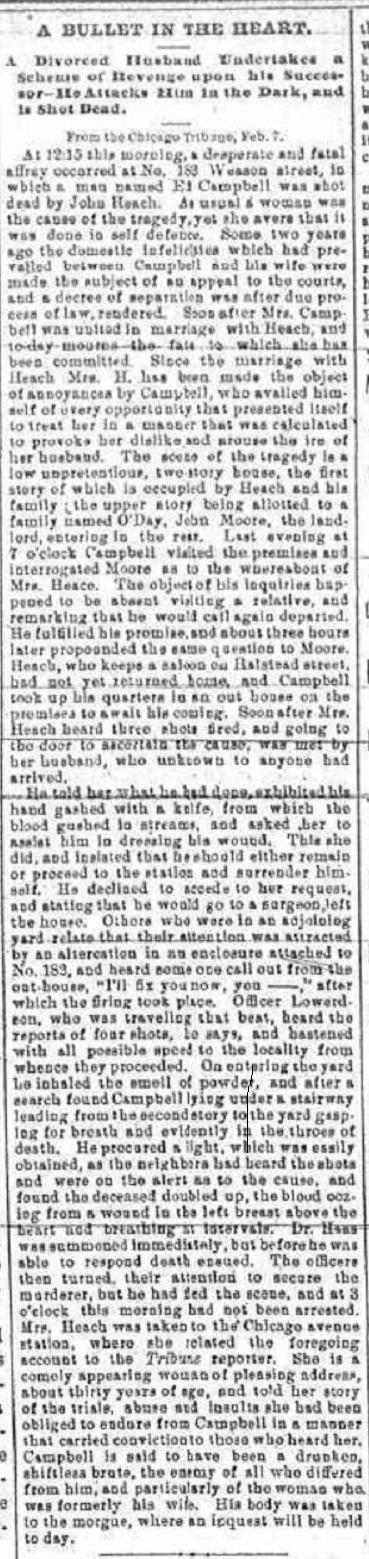
At 12:15 this morning a desperate and fatal affray occurred at No. 182 Wesson St, in which a man named Ed Campbell was shot dead by John Heach.  As usual a woman was the cause of the tragedy yet she avers that it was done in self defense.  Some two years ago the domestic _____ which had prevailed between Campbell and his wife were made the subject of an appeal to the courts, and a decree of separation was, after due process of law, rendered.  Soon after, Mrs Campbell was united in marriage with Heach, and today mourns the fate to which she has been committed.  Since the marriage with Heach, Mrs H   has been made the object of annoyance by Campbell, who availed himself of every opportunity that presented itself to treat her in a manner that was calculated to provoke her dislike and arouse the ire of her husband.  The scene of the tragedy is a low, unpretentious two-story house, the first story of which is occupied by Heach and his family, the upper story being allotted to a family names O'Day, John Moore, the landlord, entering in the rear.  Last evening at 7 o'clock Campbell visited the premises and interrogated Moore as to the whereabouts of Mrs. Heach.  The object of his inquiry happened to be absent visiting a relative, and remarking that he would call again, departed.  He fulfilled his promise and about three hours later propounded the same question to Moore.  Heach, who keeps a saloon on Ralstead street had not yet returned home, and Campbell took up his quarters in an outhouse on the premises to await his coming.  Soon after Mrs Heach heard three shots fired, and going to the door to ascertain the cause was met by her husband who, unknown to anyone, had arrived.
He told her what he had done, exhibited his hand gashed with a knife, from which the blood gushed in streams, and asked her to asist him in dressing his wound.  This she did, and indicated that he should either remain or proceed to the station and surrender himself.  He declined to accede to her request, and stating that he would go to a surgeon, left the house.  Others who were in an adjoining yard related that their attention was attracted by an altercation in an enclosure attached to No 183 and heard someone call out from the outhouse, "I'll fix you now, you ___", after which the firing took place.  Officer Lowardson, who was traveling that beat, heard the reports of four shots, he says, and hastened with all possible speed to the locality from whence they proceeded. On entering the yard, he inhaled the smell of powder, and after a search found Campbell lying under a stairway leading from the second story to the yard gasping for breath and evidently in the throes of death. He procured a light which was easily obtained, as the neighbors had heard the shots and were on the alert as to the cause, and found the deceased doubled up, the blood oozing from a wound in the left breast above the heart and breathing at intervals.  Dr Haas was summoned immediately but before he was able to respond death ensued.  The officers then turned their attention to secate the murderer but he had fled the scene, and at 3 o'clock this morning had not been arrested.  Mrs Heach was taken to the Chicago avenue station, where she related the foregoing account to the Tribune reporter.  She is a comely appearing woman of pleasing address, about thirty years of age, and told her story of the trials, abuse and insults she had been obliged to endure in a manner that carried conviction to those who heard her.  Campbell is said to have been a drunken, shiftless brute, the enemy of all who differed from him, and particularly of the woman who was his former wife.  His body was taken to the morgue, where an inquest will be held today.
Fulton NY Register, February 7, 1876
 A month later:
Incredibly, different professions around the country kept records of their trade in printed volumes that are still around--this time it's the Locomotive Engineers Journal, honest.  The man expelled from the brotherhood in the listing below might not be our man in Pierz, but he was certainly the same dude from the above article. Now we know he was trained to run a locomotive....

 Pretty cool, huh?  I always hope some relative of the people we spotlight here will google their name and realize that THIS was great-grandpa!
 Added October, 2013:
The plot thickens:
  Look at this list of granted divorces Larry found..."Matilda Heach from John H Heach, for desertion" --Chicago Tribune,  November 3, 1889.  Does it fit John's bio?  The shooting was in Chicago in 1876, and if he left town, he couldn't have become a train engineer later unless he owned another saloon, still later...AND married a woman named Matilda.  (The woman in Chicago was "Carrie", I believe, and she testified that they were never married).

If he was in Little Falls and Pierz by 1885, then Matilda had every right to claim desertion.

Thursday, August 8, 2013

George and Lloyd Harting, and John Heach?

 As we mentioned in the last post,  Little Falls was home to George and Lloyd Harting, sons of a  furniture dealer there, Harting and Sons.  George was born in 1877, and Lloyd in 1901, so together they covered a lot of artistic canvas, you might say (DAMN, I'm funny).

But WHY are we fixated on them here on HH? 
Well, partly because they were written up in the Little Falls Herald and Transcript in those years and we can't RESIST any possible connections--to wit, another article from 1906 involving our old friend John Heach*. 

  But first, there was this article in the Herald--George (the elder bro) illustrated a couple pages for "Browning's Magazine", but all I could find was Browning's Industrial Magazine.  I flipped page by page thru October, 1906, and there were no poems or interpretive drawings, just schematics and diagrams of machines.  Sigh!   If the right magazine is ever digitized, we'll add the drawings here for sure.  Don't hold your breath.

*In the meantime, LOOK at the mystery we discovered:

"The old picture drawn by a few of our local artists, of John Heach, when he defeated a LaFond mob in Bares saloon on September 28, 1900, is again on exhibition in one of our lower town [Pierz] saloons. The picture was drawn right after the battle and beautifully framed and placed in Bares saloon at that time.  Later it was placed in the American House [hotel] in Little Falls for about two years, after which it was again taken back to Pierz.  Mr Heach thinks a great deal of the picture and will not allow the saloonkeeper to dispose of it for any money."

Yes, I can hear you thinking  "fer dumb"...but isn't it kind of mystically providential that we discovered unknown (to us) artists in LF and then a mention of John Heach and a drawing of him that could still be around? Ok, ok, that's a real long shot, but wouldn't it be COOL if it was rolled up or among other pictures at the Weyerhaeuser, or in someone's attic or (horrors!) at a Pierz garage sale?  It's possible, IF it's still around, that the owner has no idea what it depicts.  We already have the staff at the Morrison County Historical Society alerted, and they're looking....cross your fingers, ok?
We'll post their answer and anything else we hear about it ☺, promise.

Tuesday, January 15, 2013

Who was John Heach?

This afternoon, Larry showed me a GREAT customized search engine he came up with to find key words on Minnesota Reflections.  He suggested I try a name--any name--from those we've researched.  I tried Otremba, and found gobs of hits, of course. One, the July 31, 1913 issue, 
had this startling headline:


Wow, could it be a misprint?  Did they mean grandpa's brother John...or the John Hesch in Agram township?  I'd never heard of a family named Heach around Morrison county, but what do I know?  
As we read the entire column, written in first person, we were still unsure if this was a relative. What he described wasn't familiar, but then.... He was supposed to have lived around Pierz for 25 years and was "well known". Hmm, did we need to do lots more research?  

The next autobiographical installment was the next week, August 7, 1913.  The headline was the same, mid front page at the top.  This John was erudite, and descriptive.  He'd evidently traveled a lot, around the world even.  WHO was he?

It's worth it to go to Minnesota Reflections online and search the word HEACH.    After those first two columns, the name is mentioned here and there, and finally there's an small announcement in 1915, of his death, with a tribute printed the following week.  We're pretty sure he wasn't one of us, that it wasn't a mis-print...see what you think.

Sunday, February 10, 2013

John Heach, Civil War Vet

Interesting, isn't it, that we started researching John Heach because of the similarity of his name to our family name, nothing more...but we found a real person and some real facts we could check out.  As in family folklore, there seems to be a grain of truth+ in what John said about himself.  Larry found him in the 1900 and 1910 Pierz censuses and then went to look for him in Civil War records, and wow--on the same page with John P SAND, there's an entry for what looks like "John H. Healh", but he was only enlisted for 3 months with a Wisconsin unit (and Ed Kerkhoff said John had a thorough knowledge of the Dane Co Wisconsin area).  HERE'S the page (p 24) on Family Search.  It's a Special Schedule of Surviving Soldiers, Sailors, Marines and Widows from the 1890 census in Morrison Co, Minnesota.  This first screen cap is from that page--

But then, the next page starts with John H. Healh (Heach), a private who served for 3 years and one day with a unit from Illinois.  Line 41 below says he was "wounded at Gettysburg", specifically a "Bayonett through Left Hand".


In his front page autobiography in the Pierz Journal, John Heach claims Civil War service, but Dr. E. H. Kerkhoff, his friend and the editor, later said he checked but couldn't find documentation about that.  Still, Kerkhoff wouldn't have had access to census records, and he certainly didn't have the internet or Larry.  ☺


  • Friday, February 1, 2013

    Let's compare photos of downtown Pierz, ok?

    Last night was rainy/stormy in Georgia where Larry is (g'head, sing along), and frightfully cold here (which sounds like I'd have been out sledding if it'd been only -5, but nope, I wouldn't have been).  So, we decided to investigate these photos of Pierz, Minnesota, instead, as anyone would.
    Four--no five--views of Lower Town Pierz--all looking north toward the church.  Larry and I were trying to figure a date for each of em.  The above, we're pretty sure, was taken in 1908.  (It came from a postcard showing four views of Pierz that SAID "1908"). 
    The last one is the Google Streetview from 2009, just for shits and giggles.

    The second one looks sharper, so it feels more recent, but there's a ragged awning on the left, an awning that looks new in picture 3.  Then too, see the outside staircase on the white building?  It's not there yet in the third photo. The wooden fire tower with the city hall steeple behind it shows in all four.  BTW, the hose-drying tower held the fire-alarm bell, too, just so ya know.

    These two guys in front of the staircase caught our interest.  I've convinced myself that the one with the white beard was John Heach ☺.  The other man, we think, had parked his bicycle a few feet away in front of the place with the Grain Belt Beer sign.  The photo is even more interesting if you enlarge it to full screen--see the car parked to their left?  Right above it a sign says "PIERZ HOTEL", and across the street on the Neisius building (nearest the viewer), we think the darker half-sign says "BANK OF PIERZ'.  Since the new German State Bank building opened in December 1916, this gives us another parameter.  The PJ mentions the bank well before 1916, and there were paid ads in the paper, too, as early as 1914. (Maybe earlier--but I noticed em in 1914 ☺).


    (Ok, it's SEVEN years later (2020!).  I finally saw what should have been  obvious--this wasn't intended as a typical street scene.  It's a hearse, heading to the church most likely.  That's why people are simply standing respectfully, hands behind their backs. Changes the whole picture, doesn't it?)

    Check the similarities between these two photos: the telephone/electric poles, which look like they were being installed in the photo below, see?  Yay, we know from the Pierz Journal that the Jacob Neisius store and home were the first electric customers in Pierz...so this, below, was July, 1912. The Pierz Journal was still in it's original building, on the left.  (We're trying to figure out what the roundish sign in front of the JOURNAL sign was for--any ideas?)

    We've speculated before that there was a photographers studio on the south end--one who was enamored  by the street and its muddy changing charm.  This one looks like the same era as #2 up there, but see the sign on the third building on the right?  We think it says BIJOU, which was the theater in town.  We'll do a post about the enterprising Faust family soon.
    I'm fascinated by the relative size of the church tower in each of the photos.  How can it figure so prominently in the first four but be almost invisible in the current one?  Even if these old pics were taken from a step ladder, the google mobile camera is mounted on top of a car.

    THANKS to Carrie P. for "South End of Main Street, Pierz, Minn."

    Sunday, August 4, 2013

    One hundred year of old NEWS

    Whoa, I already have an exciting file of interesting stuff we've found in the Little Falls newspapers from 1893 to about 1932.  For instance, did you realize that Little Falls hosted Chautauquas?  "The Chautauqua brought entertainment and culture for the whole community, with speakers, teachers, musicians, entertainers, preachers and specialists of the day".  They were the TED talks of those years.
    And remember John Heach who was written up in the Pierz Journal in 1914-15?  He was known around Pierz as a vagabond, an eccentric fix-it guy who preferred to sleep in peoples' barns.  Well LOOK what Larry found from November, 1899--John wasn't destitute after all, unless he blew thru $23,000 in 15 years, which is, I suppose, possible.  


     Here's the announcement of the birth of Dad's older sister Mary Louise, the baby who died before he was born.  She died when she was a year old, January 1911.


     "Joe Hortsch, Jr., cut his foot quite badly last week while cutting wood at home.  The foot part would not be so bad, but a brand new rubber is gone too."


     No, Little Falls wasn't a big town in 1900, except by rural Minnesota standards.  5,774 people was big enough that you didn't know everybody.  It had grown a lot in 3 years, and St Cloud was only about 3,000 people larger.
    Little Falls showed "every indication of still greater growth in the immediate future."


    And here's the obituary of Louisa (Rausch) Sand, grandma's mom.  She died at the end of 1921 at the home of her daughter, Vernie Wintermeyer, in St Cloud.  Mike Sand lived until 1931, in Buckman.

    There are a couple glaring mistakes here, like Sr Teresita, not Ccriza, and John Sand and Mrs Anton Hesch of Buckman, not John Anton Hess.

    We figure a more concise obit was published in the PJ, but so far 1921 isn't online.  We'll see, eventually.


    This ad for the 1916 Minnesota State Fair caught my eye cuz it's so....different.  It looks military, with those wings and gears  and psudo-helmet at the top.  Makes me wonder if they had a competition back then too, for the design of the posters and logo.  If not, we should remember that this was right before we got into WWI, and everyone knew we were gearing up for it.  The thought of 3,000,000 square feet of labor saving devices for home, factory and farm IS daunting.  But then, it's still what's shown at the fair ☺.


    Ok, this is just a small sample, the first installment,  of what we've found.  Stay tuned for a Mike Sand story about a missing Grittner boy, and why Genola decided against calling itself Grainville, and a few wedding announcements of people you'll recognize, and a birthday party mom attended when she was five....good stuff!