This branch of the Austrian Hesch family is descended from Johann Hesch and his wife Marya (Schlinz) Hesch, who came to America from Oberschlagles, Bohemia with three sons: Paul, Mathias, and Anton. +++Johann & Marya settled in Buffalo County, Wisconsin but moved to Pierz, Mn in about 1885. .+++Mathias settled in Waumandee, Wisconsin and moved to Pierz in 1911. +++Anton never married but farmed with his dad in Agram Township, where he died in 1911.+++And Paul, my great grandfather, settled five miles away, in Buckman, Minnesota. He died there in 1900.

: : : : : : : : : : : :

Saturday, November 27, 2010

More about St Cloud in 1938-39

Here are four pages of pure history, even if you're not from St Cloud, Minnesota and don't recognize any of the names and businesses.  It's a snapshot of a Minnesota population in 1938-39 who were mostly the children of immigrants.  I see clear evidence of the German influence, as in the listing for Northern Pacific Ry where the freight and passenger depot is 551 and 555 do (ditto). I see the name of a woman who was old when I was a young aide at Good Shepherd Nursing Home in the 60s.  I see companies that have survived, and companies that haven't, even tho they were in business when we were kids.  Most of the occupations (slsmn, instr, formn, lab, atndt, tchr, plstr, mgr, hlpr, mach) are still around, but listing them pretty much meant they were permanent jobs--chances are if you were a carp this year, you'd stay a carp in the future. 
I marvel at how people were listed as "moved to Alexandria" or "died April 1935, age 69"...or "wid Frank J".  It really was a small town then.  
See who the big employers were in 1939?  The granite industry,  railroads, the VA, retailers, NSP,  Northwestern Bell Tel, not to mention the endless insurance companies

'Course, Klock's Tick Tock Cafe, the Powder Puff Beauty Salon, the Lily White Laundry and the OK Cafe employed people, too.
::::  
Isn't this just COOL?


Why we heard of Glendive, Montana

Sit back, put'cher feet up--we have a saga to tell you about....

Now.  In 1823, Johannes Georg OTREMBA married Suzanna Preussner in Groditz, Tillowitz, Schleisen, Prussia.  Together they had 9 children, one of whom was Johann from the post below, and another was Anton Otremba, our great-great grandfather (Yeah, that's how we connect ☺).

For some reason, Larry and I keep running into info about Johann's descendants here in the US, and accidental cross references, too.  (Course, if you LOOK for obituaries, you're bound to find connections).

As we said in yesterdays post, Johann and Anna Rosina had 8 children who lived to adulthood.  One was Martha, who married Jacob Niesius.  Her obit is below:


THE PIERZ JOURNAL - January 30, 1930

---------------------------------------------------
Stroke is Fatal to Mrs. Jacob Neisius
Died almost Suddenly at Her Home In the Village;
Bural Here On Friday Morning
--------------------------------------------------------
What came as a shock to villagers and country people here about Tuesday morning, was the news of the death of Mrs. Jacob Neisius of this place. The death of Mrs. Neisius occurred at her home at 12:05 a.m. Tuesday following a stroke which she suffered at 7:30 Monday evening while working about her home. She had not been ailing previous to Monday evening although she suffered a similar stroke many years ago and another about two years ago.
Mrs. Neisius whose maiden name was Martha Otremba, was born in Grotizin, Prussia, September 11, 1870, and came to the United States with her parents at an early age. The family settled two miles west of Pierz. Her marriage to Jacob Neisius took place in Pierz February 5, 1888, and the Neisius family has resided in this village since then.
Surviving are the husband and eight children: Mrs. Peter Kelzenberg, Genola, Mrs. Al Solinger of Clearwater, Mrs. Arthur McNabb, August A., Frank, Alex, Celestine and Florence of this village.
Mrs. John Dombovy of St. Paul and Mrs. Theo. Stumpf of Genola are sister of the deceased and Charles Otremba of Golden Valley, N.D., is a half-brother of the deceased.
On Friday morning at ten o'clock in St. Joseph's church in this village will be held the burial services for the deceased Mrs. Neisius. Interment will follow in the Pierz cemetery.


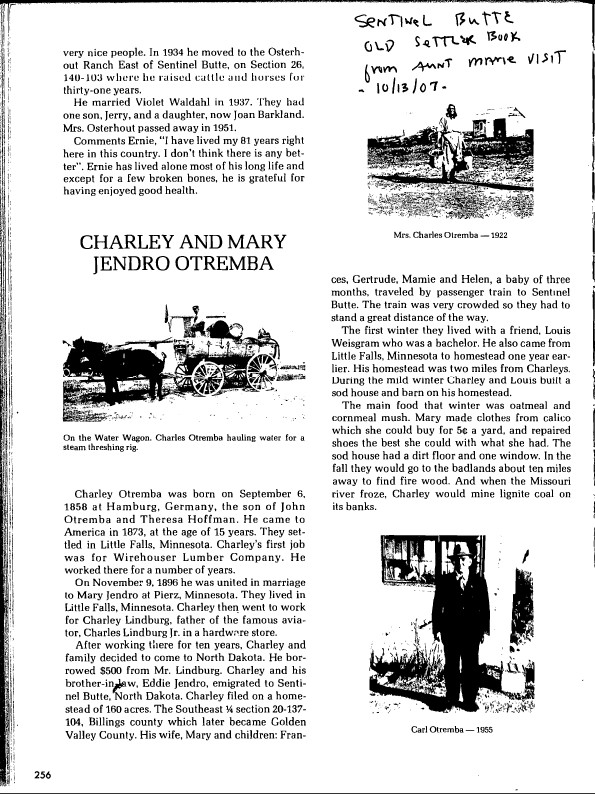
They (Johann & Anna Rosina) also had a son named Charles (Karl), who married Mary Jendro from Little Falls.  They lived in LF for a few years, and then moved to the other end of North Dakota, very near the Montana line, and built their life there. (See? The reference in Martha's obit is to Golden Valley, North Dakota). Below you'll find two pages from an "Old Settlers" book published about that area:

(The second page has only a little about them, but I just couldn't get rid of the rest of it--look how COOL the Oygaard brothers were!)

Anyway, from other obits Larry's found, we know they goofed some of the facts there, OR, since the bio was given after Charley and Mary died, maybe the next generation just didn't know the real facts.  In any event, it's cool to find some of "us" so far away, huh?

 But wait--there's more!

Ok, yes, we've written about this branch before, on January first 2010.  But now, with the obit Larry found this week (below, Edward Scherman), the wedding photo clicks, too.


But back to WHY Glendive, Montana was a town we heard about as kids:  click the map below--I'm not positive, but I suspect dad and Uncle Tader knew the Otremba relatives in Golva and Beach and Sentinel Butte.  Glendive is the closest larger town.  Ok, it might just be a town we aimed at as we drove across endless North Dakota.

Still, I prefer thinking it had a family connection.

Thursday, November 25, 2010

A 33 year old Christmas photo


It's the 25th of the month, so here's a pic of my kids being VERY GOOD right before we opened presents...lol

So, so sweet!

Tuesday, November 23, 2010

Not a Hesch after all

If you've followed HH, you might remember an anomaly that's been bugging us for ages:

 WHO was Johann Otremba's wife?
Johann was born in 1831 in Schleisen (Poland).(See his obit, below)  He married Anna Rosina there when he was 24 and she was 22.  They traveled to America in 1873.

Fast forward to the 1900 census in Buh township (Pierz) where they'd retired.  It says they'd been married 45 years now, and had 10 kids with 8 still living.  They were 68 and 67.  She died 3 years later, and he died 9 years later.

When I found this page ► at the Weyerhauser Museum in Little Falls, I already 'knew' about Anna Rosina, and the note written there confirmed it--she was a Hesch!  But...where did she fit?  As far as we knew, the Hesch clan was from southern Bohemia, 250 miles southwest of Opole, Poland.  HOW would they have met?  But that was a question for later--we had other stuff to discover.  Still, Larry and I've come back to this Q over and over.......


Yesterday, Larry had a brainstorm--
Q: WHERE could we find a woman's maiden name?  
A: On the death certificates of her children, if they were lucky enough to die in Minnesota! 
He looked up three of their kids, and there's our answer:


Name Frank Otremba
Gender Male
Burial Date
Burial Place
Death Date 11 Feb 1926
Death Place Saint Cloud, Stearns, Minnesota
Age 65
Birth Date 1861
Birthplace
Occupation
Race
Marital Status Married
Spouse's Name Rose Otremba
Father's Name John Otremba
Father's Birthplace
Mother's Name Rose Schultz
Mother's Birthplace
Indexing Project (Batch) Number B07186-0
System Origin Minnesota-EASy
Source Film Number 2218722 

Name August Otremba
Gender Male
Burial Date
Burial Place
Death Date 31 Jul 1927
Death Place Pierz, Morrison, Minnesota
Age 62
Birth Date 1865
Birthplace
Occupation
Race
Marital Status Married
Spouse's Name Anna Otremba
Father's Name John Otremba
Father's Birthplace
Mother's Name Anna Rae Scholtz
Mother's Birthplace
Indexing Project (Batch) Number B02493-4
System Origin Minnesota-EASy
Source Film Number 2223131
Reference Number 8262

Mary Rose Otremba 
Name Mrs. Theo John Stumpf
Gender Female
Burial Date
Burial Place
Death Date 20 Mar 1937
Death Place Little Falls, Morrison, Minnesota, Us
Age 70
Birth Date 1867
Birthplace
Occupation
Race
Marital Status Married
Spouse's Name Theo John Stumpf
Father's Name John Otremba
Father's Birthplace
Mother's Name Rose Anna Schultz
Mother's Birthplace
Indexing Project (Batch) Number I09899-6
System Origin Minnesota-EASy
Source Film Number 2243105
Reference Number 8820


SO....since the least weird answer is often the best answer, for now we're going with 
ANNA ROSINA SCHULTZ.  

Heaps more thanks to Larry ☺

Monday, November 22, 2010

Stuff that doesn't fit anywhere else

There's so MUCH in magazines from a hundred years ago that I think is neat:
Inspiration from 1904

What train whistles meant circa 1904  (Math Hesch's 2 long and 2 short was  their phone ring and had nothing to do with trains..altho, you were kinda 'crossing a road at a grade' on that corner, huh?)

A tool dad used a lot ☺ and that I thought was SO clever!


ALL the businesses in Sauk Rapids in 1880

I would have LOVED this set!
This ad brings so many questions to mind, like, how come the First Hawaiian Conservatory of Music was in NYC?
St Joe in 1898--my lot
wasn't even in town back then...

This is in honor of my nice niece Laurel who achived 29 last week--
she graduated from Tufts in Engineering, ya know!

Saturday, November 20, 2010

Heinz found Shedliske!

Note: Sunday, Nov 21--This post is mostly wrong, ok?  (Crossing-out one sentence is funny, but a whole post is overkill.  Leaving it, however, is a lesson to me about not jumping to conclusions, and also about remembering what info we've ALREADY FOUND!  Jeeze....)
As we investigated Louisa Rausch Sand (dad's maternal grandmother), it seemed like all the (family tree) documents online give her birth village as SHEDLISKE, Prussia.  Hmm.  Curious to know where in the world that was, I tried JewishGenWeb's Schtetlseeker pages--it's a marvelous listing of practically every town or village in Eastern Europe, in each of the languages, too.
So, I tried Shedliske.  No results for that spelling, but more than 20 places in Poland called SIEDLISKA.  Larry and I have learned to translate words that seem "too common" in their context, and this was one instance.  Siedlisk means Habitat....so they were.....villages named Village?  Would it be like me saying I come from Town, Minnesota?  Might it have been immigrants giving an "It-doesn't-matter" answer rather than making a big deal of exactly what town they came from?  So far, we don't know.
Sure, it's possible the Rausch family came from a Shedliske that doesn't show up on Shtetlseeker, but I think it's actually a mis-spelling on our part, here in the states.
If you know different, let me know, ok?


LOL--vielen dank to Heinz Binder, our kind relative in Austria, who sent this link this morning  without any snotty remarks:


http://ortopedianew.appspot.com/wiki/Powiat_Falkenberg_O.S. 


It's a wiki page in Polish and...YES,  Schedliske was in Falkenberg, just like Guschwitz (where the Otrembas came from).
Population from the 1910 census:
Guschwitz - 538

Schedliske - 56

LOL...then,  this morning on Instant Messenger, Larry reminded me of Rev August Rausch who was Louisa's brother, and who we'd made the connections to in May, 2009  Duh.


BUT, what we didn't know before was WHERE Schedliske was, and now we do.  Oh, and Larry also found this on Google Books:


A Schematic of  Germans and German speaking Priests, from 1882,  page 127:
Theres August RAUSCH, born 27 April 1847 in SCHEDLISKE, Schlessien (Breslau).

Friday, November 19, 2010

Three Questions


Yes, these cast iron bugs are strange looking, but it's cuz they were/are used for something unrelated to insect life, so question #1 is   
What are they used for?


This charming, slender kid is me at 11 (and yes, I thought that purse was WAY COOL).  We were at a zoo, but it wasn't Little Falls or Duluth.  (I know, only the sibs might be able to answer this one--just look DEEP into the deer's eye.....deeper.....
Question #2 is 
Where were we on that particular vacation?
And this is Question #3--Which cousin is this?
(Doncha just LOVE these quizzes?)

Thursday, November 18, 2010

He's no longer lost!

For a man I thought was "lost" to the family, we keep finding documentation of Charlie Steven Sand.  Ancestry recently published more military records--this batch is from the "old man" draft in 1942 for WWII.  We'd found Charlie earlier, in Duluth in 1917 when he signed up for WWI, and here's his second registration card 25 years later, in Wenatchee.

Oh, and thank gawd for the excellent records Washington state has online--here's Charlie marrying his second wife, Nellie.  Isn't that cool?
(Thanks for thinking of Charlie, Larry)

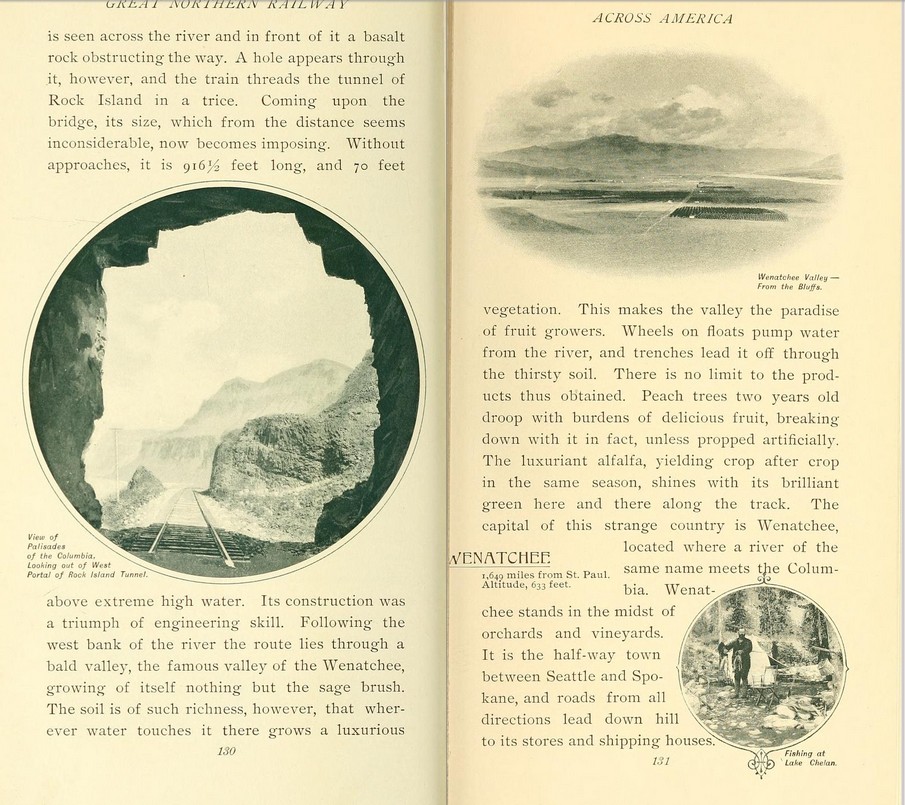
ADDED LATER: I was looking for train drawings, so I tried "Great Northern" at Internet Archives and found this travel book.  I think it was intended to be a fun read on an endless train trip across the country.  Below are a few pages from Washington state.  It sets the stage in the country around  Wenatchee, and you can see why Charlie and Elizabeth chose it--


(This just TICKLES me! ☺ )

Wednesday, November 17, 2010

Telephony from Technical World Magazine, 1905

The old magazines at Internet Archives are endlessly fascinating to me.  They give us a picture of the world then, as technology was developing and new products were introduced for future benefit.  (Technical World also offered lots of ads for patent lawyers, natch).  

Below, there's a reference to "Tesla", as tho everyone would know who that was.  He was Nicola Tesla, and look!  He predicted the cel phone, in 1905!  

That particular issue has quite a long article about telephone technicalities--it ought to be fascinating to a few of you!

Monday, November 15, 2010

Magdalena Sand 1894-1987

Grandma Lizzy (Sand) Hesch had a little sister named Magdalena, but everyone knew her as Lena.  She was the youngest girl, second youngest kid, and the last one left after Frank died in 1979.
I remember going with Aunt Fronie to visit her at her house in Pierz, south on the street behind the church.  We talked canning, and sauerkraut, and she named all the people in the family picture I brought along (the 1896 picture of the whole Mike Sand Family) while I wrote them down. I remember her talk was liberally sprinkled with German words, and I hadta keep asking 'What?'  She did it purposely and got a big kick out of it, too.
I remember her being feisty and fun...and not inclined to put up with "dumb stuff".  She had a quick mind and wit.  I only wish I'd taken the time to know her better.


Sunday, November 14, 2010

Rural road building in 1883

There's a really wonderful old book (set of books?) published in 1883 which pretty much walked you through how to do EVERYTHING on the farm, and why.  Most immigrant farmers would have benefited from these books if they could have slogged thru the verbiage, and also realized that the 'farm' he speaks of was NOT in Central Minnesota...lol


For instance, dad mentioned maintaining roads in the Buckman area with the team.  Reading "Rural Roads and Bridges" starting on page 838, I'd be really surprised if that much care was taken to "do it right the first time".  In fact, I imagine that roads were mostly wagon tracks that eventually got dragged smooth by the nearest farmer who couldn't stand the low spots any longer...  
....that never existed in rural Minnesota!


There were mentions of corduroy roads and contracts to haul rocks for road repair in the Buckman News column of the Little Falls Herald.  (I asked my 91 year old "consultant" what that was all about and he said the rocks acted like a culvert, letting water flow thru under a road).  None of that was according to The American Farm and Home Cyclopedia. ☺
Once you've clicked the link to the book, scroll back and forth.  There's info on all kinds of things you've wondered about, and a lot you didn't think to wonder about!


Friday, November 12, 2010

Two articles you'll love


"The Pacific coast is only twelve days from Lake Michigan by bus..."  Wow, how could  you resist a come-on like that, especially when THIS was the bus?
Anyone who's worked at Glacier National Park (Hi, Noob!) or visited there will recognize the tour bus in the picture.
I believe you'd think "endless twelve days" rather than "only"....but its a cool illustration, anyway, right?
I think it's from Technical World Magazine, which eventually became Popular Mechanics.
(So, ok, this is not an article, and I have no idea which issue the drawing came from.  Still, you'd love Technical World if you flipped thru an issue, I just know it.  HERE'S the one from April, 1905.  See??)


 And THIS article is from the American Bar Association Journal,  March 1963 issue.  It's by a young lawyer named John Simonette, and it's pretty funny....(click to enlarge).


Thanks to Larry for finding this ☺

Thursday, November 11, 2010

Lake George, St Cloud, Mn

For more St Cloud history, check "St Cloud" in the sidebar or search "Lake George", above left...you're welcome!  ☺

I've wanted to do a sort of illustrated timeline of how the size and shape of Lake George has changed over the last 150 years, but what I still needed were the dates, cuz I have a nice collection of pictures ☺.  Ha!  All it took was mentioning it to our favorite researcher, and he came up with a website called "Placeography: A website about any place anywhere that anyone can edit".  And THERE is a page about Eastman Park, which is the city owned land adjacent to Lake George.  Well, OKAY!

Birdseye view in 1896
"April 1855 - R.B. Blake, the first surveyor of Stearns County, records the existence of a 7 1/2-block lake in the plat book and names it Lake George.


December 1867 - John Coates created a skating rink in the park and describes it as the largest in the State.
From Harold Zosel's book of postcards, 2010
May 1876 - Lake George was drying up because it was so shallow. In response, citizens petitioned the City Council to do something about the Lake George problem. They suggest building a dam to raise the water level and using the lake for the town's water supply. They also wanted the City to acquire land around the lake, install a road, and turn the lake into a City park.
September 1888 - The City Council orders the street commissioner to construct a boulevard around Lake George. After numerous delays, the project is completed in the early 1900s.
St Cloud plat map, 1896


February 1926 - St. Cloud Ice Co., which had sold Lake George ice to St. Cloud residents for more than 25 years, sells 21 acres of Lake George to the City.
December 1926 - The City makes an agreement with the Minneapolis Dredging Co. to dredge Lake George. The company removed 215,000 cubic feet of mud and used it to fill in the north and south ends of the lake. The project cost the City $57,800. During the process, workers discover a huge granite ledge on the west side of the lake, which at its highest point is 9 feet from the surface.
September 1928 - workers completed the dredging of Lake George and turn an unattractive area into a municipal park and recreation area. A shallow 23-acre swamp became a 7-acre lake, 35 feet deep in spots.
Lake George about 1900

October 1928 - Citizens constructed a giant toboggan slide, 45 feet high and 200 feet long on the lake's southwest corner. Lake George became extremely popular for leisure skating, skating shows, sledding, and winter carnivals.
July 1947 - The St. Cloud Municipal Swimming Pool was dedicated. The pool was Minnesota's first outdoor Olympic-size pool and cost $170,000 to build. The dressing house was Georgian Revival style and was built during the Works Progress Administration. In the 1950s it was used by as many as 2,000 swimmers a day, 60,000 in the summer of 1955.
June 1969 - Area businesses, groups,and individuals started raising funds for a fountain in the middle of Lake George. The fountain was installed in 1973.


Note: Wow,  someone wrote a whole article about the Lake and forget to mention the SWANS?  They were the main feature about Lake George when I was a kid. (Ok, ok...I could go edit the article myself, right? ☺)


Lake George in the distance, 1969
November 1978 - The landmark warming house at Lake George is demolished. It was built in 1936 through the Works Progress Administration with materials from the Pandolfo Plant. A new warming house is building south of the old site.
                                                     September 2002 - The St. Cloud Municipal Swimming Pool closed because of declining attendance and the need to replace an expensive chlorine treatment system. (This is where most area kids learned to swim, including us) Brrr!
June 2007 - A new splash pad was installed to replace the swimming pool. Also, a public restroom and concession building, plaza, picnic areas and new playground area was completed to complement the historic character of the area.
May 2008 - The Lake George Community Center opens in Eastman Park. The community center is housed in the historic dressing house. The dressing house building was reused with a complete interior remodel. The historic character of the dressing house was preserved".

This is Lake George today.  It's still used for skating in the winter, when the city plows and polishes a nice large rink.
Lake George originally was a swamp that drained to the Mississippi thru a ravine (top picture).  All that's left of the ravine now is the last bit along Highbanks Place, north of the SCSU campus.
It's still a pretty place to be, with a well used asphalt walking path all the way around, too.


OMG, how St Cloud's changed, huh?